Sunday, June 11, 2017

Toad Spring

This spring, numerous toads have been seen by the pool, on the driveway, in the gardens and meadows. They have all been the Eastern American Toad (Anaxyrus americanus), as pictured here, with bulging eyes, a dry, ruddy complexion and covered in brown and golden bumps and warts. 

This toad is larger and lighter in color and likely a female. She found a crevice in our walkway, where she dug a hole and hides among tiny plants and seedlings, waiting for some food to fly by.


Another toad hides out during the day on the back patio near the pool. This one is much darker in complexion, smaller and probably a male. 


Unlike frogs, toads can spend more time on land, although, during mating season, they can be found by water sources. This is when they get into trouble and can find their way into a pool and drown. 

I'm reading a new book by Nancy Lawson, called The Humane Gardener, 


where she suggests using a Frog Log: A Critter Saving Escape Ramp, which provides an angled, easily used escape route. It can be bought online, it's easy to set up and can be used not only by frogs and toads, but also by baby birds, spiders, beetles, bees, snakes, etc. 


I bought 2 Frog logs and placed them next to the skimmers, upstream from the water flow. I haven't found any animals in the skimmers since. 


Here is a clear explanation about the differences between frogs and toads: http://allaboutfrogs.org/weird/general/frogtoad.html

This site identifies the different frogs and toads of PA: http://www.paherps.com/herps/frogs-toads/

Nancy Lawson has a lovely and informative website: http://www.humanegardener.com/

Thursday, June 1, 2017

Deer Paparazzi

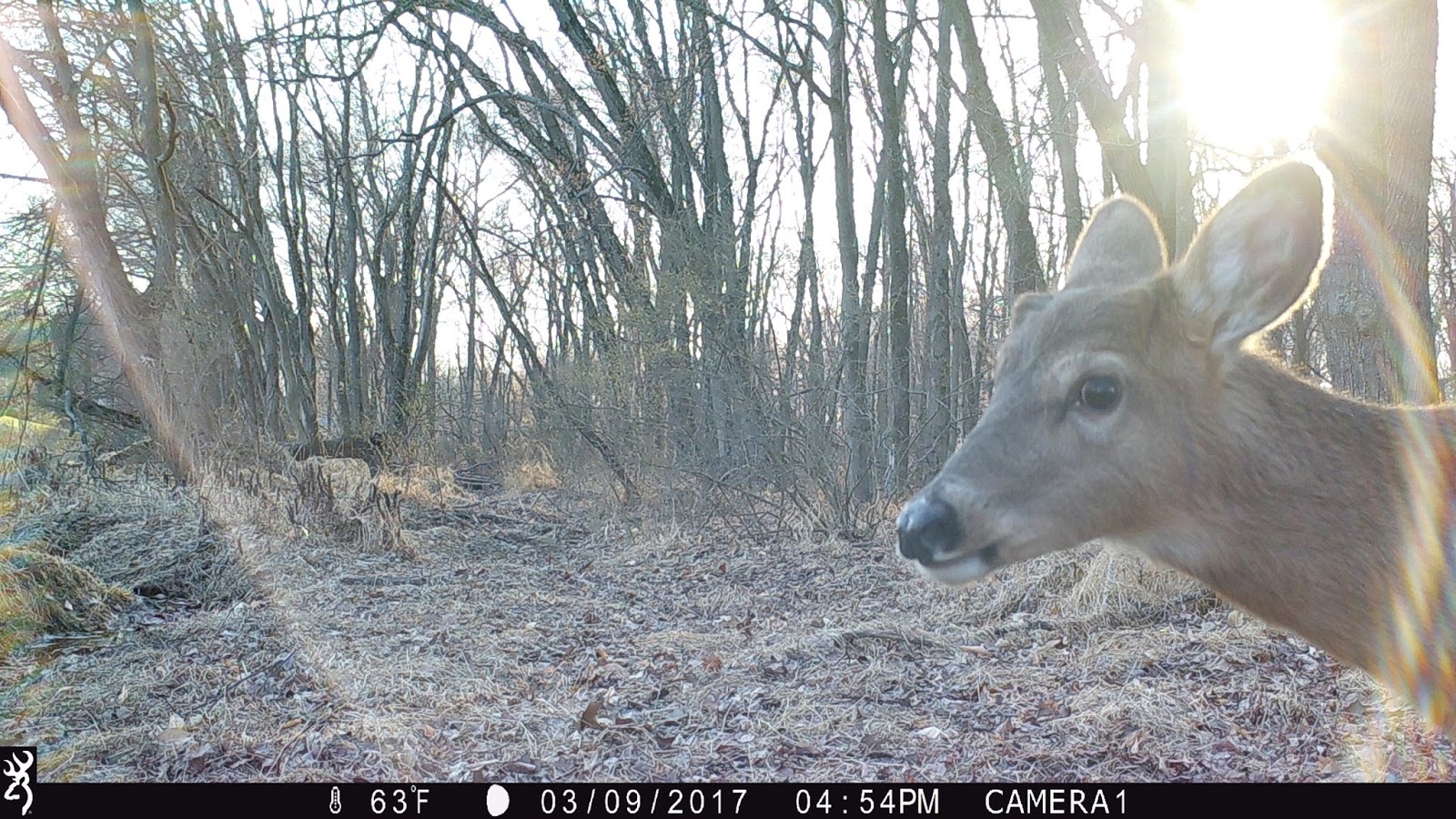
We have many deer on our property every day, sometimes as many as 25. 

Using my new trail camera, of course, most of the photos are of deer, but this series is my favorite, shot by the creek in the lower meadow during sunset.

This female is so curious and stops to check it out. 


 I love how she circles back around to investigate further. 


 Maybe if she sniffs it, she can figure out what it is.


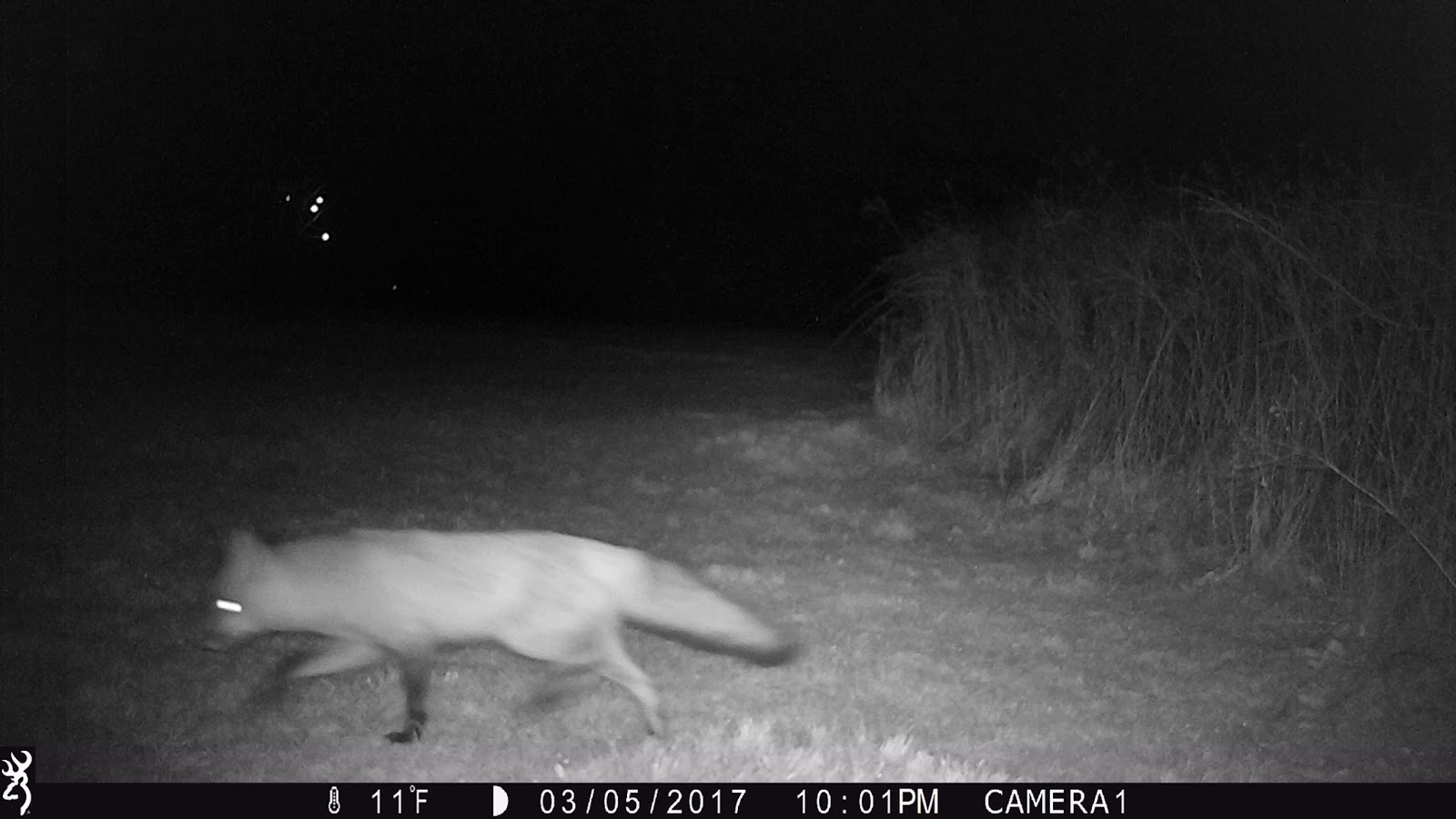
and that night, look who goes whizzing by:


Monday, May 29, 2017

Winter Fox

For Valentine's Day, a long time wish was realized: 
a Browning Trail Camera 
with night video and photo capability. 

I was surprised to see all the fox action at all hours this past winter. 

I positioned the camera on a cherry tree, located at the lower meadow on March 5th.
It's around midnight and only 5 degrees. 


I repositioned the camera on the opposite side of the same tree, to see if I could capture the fox coming towards the camera and I did. The camera must make a noise or project a light to startle the animals each time.

Here is the fox around 7 p.m and 20 degrees out. He comes shooting by again at 10 p.m. and now 11 degrees out.


I was curious if there were fox hunting in the upper meadow, too. I caught a glimpse of this one during the day, headed up the middle path on a cold, sunny day on March 11.


A couple of weeks later, a fox trotted by near the upper meadow during a snow storm at 3 a.m. and 22 degrees out. 


With all this fox action, I was curious if it was a female and with a den near by. 

I never did find one. 

Sunday, February 12, 2017

Birdhouses Closed for Business

Before the birds begin making their selection for new birdhouses for the season, we chose this grey, cold, wet day to get the houses cleaned out.


Some interesting finds and observations included:

> One nest had a prominent blue jay feather featured, although it hadn't been used by one:


> Three plumb mice promptly jumped out as we removed the thick nesting material, jumping wildly into the air, practically onto us, but landed in the snow below and scurried away:


Another house, at the top of the property and usually used by bluebirds, had a small, very messy, loosely built nest made of small twigs and moss. It looked like it must have been very uncomfortable for baby birds:


We have never seen this type of nesting materials in this birdhouse before. Perhaps, it was a Carolina Wren's, Northern Mockingbird's, or Great Crested Flycatcher's nest? 

Northern mockingbird nests are composed of a lot of twigs, and seem to resemble the nest we found the best.

(Photo: http://4.bp.blogspot.com/)

As we made our way back to the meadows, we flushed out a very wet Coppers Hawk, who routinely can be seen here, by the vernal pond:


The newest birdhouse hasn't been used recently and was completely free of bird nesting material:


The birdhouses will all be left wide open this year to hopefully break the cycle of house sparrows using them.


Every bird is on their own for the nesting season this year!

Friday, October 28, 2016

Swallowtail Butterfly Mimicry

While I was out to the garden, collecting a sprig or two of parsley for a veggie stir fry, I was startled by a beautiful caterpillar:


When I looked closer, there were over 10 of them in my parsley patch.


After some investigation, I identified them as the Eastern Black Swallowtail Butterfly (Papilio polyxenes) caterpillar.

They start as a little greenish-yellow iridescent egg, from which emerges after 4 to 9 days, depending on the weather, a black larvae, with a conspicuous white saddle, which mimics bird droppings. This stage lasts 10 to 30 days, and includes several instar phases and a caterpillar.


Another 9 to 18 days, as a pupa, are needed to become a butterfly.

Black swallowtail butterflies frequent the zinnia garden, 


but wait, after some double checking, I find these butterflies are NOT Eastern Black Swallowtails, but a dark morph of the female Eastern Tiger Swallowtail (Paplio glaucus) and their caterpillar looks like this:


Female Eastern Tiger Swallowtails are dimorphic and this chart from Wikipedia shows the differences :


3 - dorsal female dark morph; 6 - ventral female dark morph

"In the dark morph, the areas that are normally yellow are replaced with dark gray or black. A shadow of the "tiger stripes" can be seen on the underside of the some of the dark females."

From one of the photos above, I zoomed in closer, and indeed, you can see the "tiger stripes":


So the differences are easier to identify, pictured below together are the female Eastern Black Swallowtail and then the female Eastern Tiger Swallow tail- dark morph.

Note the prominent white spots on the body and wings, for starters.


Eastern Black Swallowtail (Papilio polyxenes)


Eastern Tiger Swallowtail - dark morph (Papilio glaucus)

There is also a Spicebush Swallowtail (Papilio troilus), which also looks similar:


and all these dark swallowtails are mimicking the poisonous Pipevine Swallowtail (Battus philenor)


This is called Batesian mimicry, where the butterfly's resemblance to a noxious one, protects it from predators.

There are numerous interesting scientific articles on the subject, but these two studies are especially relevant. In Evolution (33 (1) March 1979), "Batesian Mimicry: Field Demonstration of the Survival Value of Pipevine Swallowtail and Monarch Color Patterns" by M.R. Jeffords, it was shown that mimetic swallowtail butterflies have longer survival times, and are less frequently and vigorously attacked by predators.

Also, why are only the females mimetic? 

In an article in Trends in Ecology and Evolution, titled "Diversity in mimicry: paradox or paradigm", by M. Juron, three possibliities are offered, including 1. being mimetic reduces mating success in males, 2. reduces success competing against other males and 3. since females are more vulnerable to predators because of their predictable behavior while feeding, mimicry would offset this. 

Here is a link to the full article: 

A simple visit and observation in the garden led to just a peek 
into such a fascinating and 
complex world. 


Monday, July 4, 2016

Carpenter Bees, Blueberries and Catbirds

In early spring, a queen Carpenter bee took up residence right next to our blueberry field. 
See the hole on the post to the right:


She regularly worked the blueberry blossoms, pollinating them, one by one, day by day. 
This helped ensure fully developed fruit.

She attempted to make additional homes in the poles, as you can see here, with her flying around, checking out different locations,  


and then actively chewing on the wood.


This is what her home looks like inside the post:

After mating, the female will burrow like this into untreated wood and lay eggs in a series of cells, providing balls of pollen for the larvae to feed on. The adults emerge in late summer.

(https://entomology.ca.uky.edu)

Four of the 14 bushes were netted to keep the birds out.


The 6' foot bushes were ladened with fruit this year, thanks to the excellent pollination by the Carpenter bee. These bees are also important pollinators for eggplants and tomatoes. 

Carpenter bees are the largest native pollinators in the US. 
They emerge in early spring and work early in the morning until late in the evening. 
They have a medium length tongue, are sturdy, with a hairy thorax and a shiny black abdomen. 
These bees can travel up to a mile. 

(See a previous blog entry on March 12, 2012)


Every day, at least 2 - 4 Catbirds found their way into the netted enclosure. 
This has gone on for 2 weeks. I went out twice a day to check and let them out, where they then dashed back into the thicket, turning to meow, squeak or squawk at me.

It was always Catbirds! 

Gray Catbirds especially love blueberries and other fruit. 
They are mimics repeating a variety of sounds and can sing a song for up to 10 minutes.


Here is the first bowl. 


Yesterday afternoon, I went out and found 5 Catbirds in the enclosure and decided to go ahead, take down the netting and pick all the berries. 

After picking over 2 hours, 
the total collection came to 19 pounds or 27 pints.

There were still lots of berries left on the bushes and as I came out to the field today, I found over 10 birds feasting, including Thrashers, Robins, Sparrows and 
Catbirds, of course!