Showing posts with label monarch. Show all posts

Thursday, September 21, 2017

Milkweed, Monarchs and More: A Field Guide

I recently was visiting Cape May Observatory and found this little field guide, filled with great information, including all the different milkweeds, and the many Anthropods it supports, including especially insects and arachnids.


Their colorful Role Codes are fun, too, identifying visitors as herbivore, herbivore that eats milkweed, nectivore, predator, parasite, decomposer or passerby.

Here is a taste of what you will find inside:


It includes 2 pages devoted to the different ladybugs beetles you might find on milkweed. 

I highly recommend this book, especially if you enjoy milkweed, butterflies and insects.  

Wednesday, August 16, 2017

Buffet at the Milkweed: Milkweed Tiger or Tussock Moth

After a deluge yesterday, the day started with deep fog and a cool humid 69 degrees. After the fog lifted, I headed to the side and upper meadows, ducking many new spider webs,


sighting a gold finch flitting by and counting 5 monarchs sailing through. The monarchs are headed south, focusing on golden rod and any other rich nectar providing plants, where they can get a quick fix.

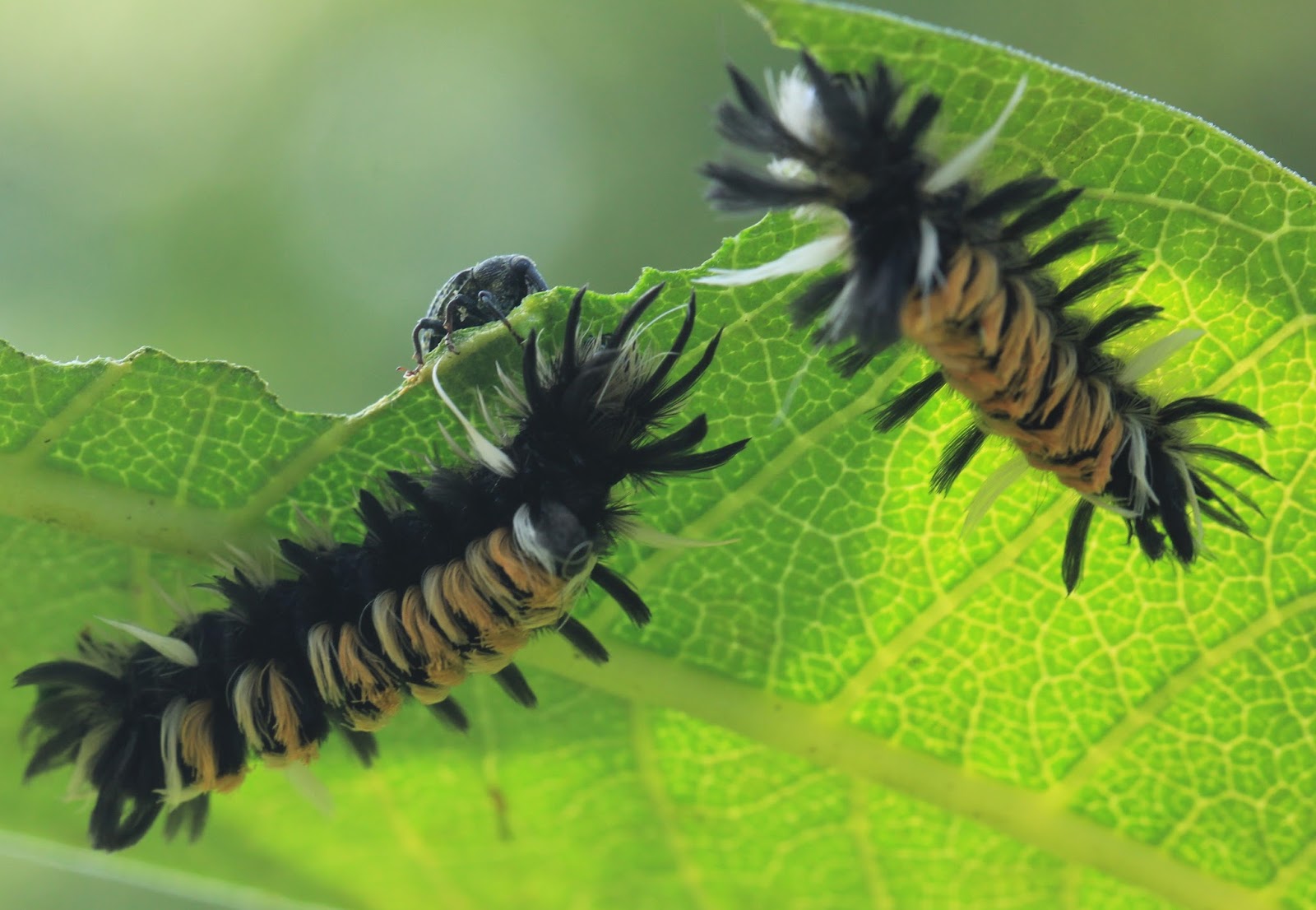
As I walked along the path, I spotted several shaggy gold, black and white caterpillars, busy eating and eating away at the milkweed and leaving huge holes in the leaves.


Many of them were positioned under the leaves, too, either hiding from predators or preparing for the next stage and hanging out in groups of two. I bumped into the plant and the caterpillars quickly balled up and just tumbled to the ground, another mechanism to ensure their survival.


They are the Milkweed Tussock Moth (Euchaetes egle) and they use the chemicals, i.e. cardiac gycosides, from the milkweed to deter bats and other night predators. Their prickly hairs are covered in poisons to insure they are unpalatable to any birds or other curious creatures.

Look at their tiny sucker feet or prolegs, which they use to hang on to the leaves:


Before long, they will pupate into small grey cocoons, overwinter and then emerge in the spring as this beautiful hairy grey moth:

(https://upload.wikimedia.org/wikipedia/commons)

For further details and information, visit: http://bugguide.net/node/view/433

Wednesday, October 21, 2015

Autumn Meadow Plants Series: Part I - Shift from Common Milkweed to Dogbane

There has been a dramatic shift in the diversity of plants in the upper meadow this year. The Common Milkweed population has plummeted from over 1000 plants to just around 50 and it has been replaced by another milky sapped plant, Dogbane (Apocynum cannabinum). (See Blog entry: July 7, 2014 for earlier story)

The meadow went from looking like this:


to this, in just over a year: 


There is greater diversity, than just 2 years ago, including many hardwood tree saplings including Sweetgum and Black Cherry, numerous grasses and the following plants:

Canada Goldenrod (Solidago canadenis)
Pokeweed (Phytolacca americana)
Yellow Toadflax (Linaria vulgarius)
Black-eyed Susan (Rudbeckia hirta)
Common Ironweed (Vernonia fasciculata)
Wild Carrot (Daucus carota)
Common Yarrow (Achillea millefolium)
White Heath Aster (Symphyotrichum ericoides)
Canada Thistle (Cirsium arvense)

In this entry, the focus is on the expansion of Dogbane, what it is and its role for pollinators. 

Dogbane or also known as Indian Hemp, grows 2 - 5' tall, is smooth, red-stemmed, which are filled with a milky, latex sap that is bitter tasting and highly toxic. It prefers full sun and wet soil and spreads aggressively from underground rhizomes. 


In early summer, it produces a grouping of small fragrant white flowers which are an excellent nectar source for many pollinators, including many different types of bees, butterflies, skippers, fritillaries and is a host to many larvae of various moths.(See: http://www.illinoiswildflowers.info/prairie/plantx/dogbanex.htm

Historically, this plant's silky fibers were used by the Lenni Lenape and other Native Americans to make robe, netting and baskets. In the fall, long seed pods hang in clusters and pop open as they dry, to expose seeds, which are attached to white silky threads to help them float long distances. 


Common Milkweed and Dogbane are often mistaken for one another due to similar leaf shape and plant size and shape and flower clusters. Because it contains a milky, poisonous sap as Common Milkweed and serves as a host to many other pollinator larvae, I wondered if it was also a host plant for Monarchs? 

It is NOT, according to Robert Dirig of Cornell, who confirmed that Monarch definitely do not use it as a host plant. (See: http://flnps.org/native-plants/spreading-dogbane-and-butterflies)

The question remains of why Dogbane out competed Common Milkweed. They both have deep aggressively spreading rhizomes and prefer disturbed ground, sun and wet conditions, which are all present in this meadow. Perhaps, Milkweed has encountered a disease or a pest 
(see: thttp://www.monarchprogram.org/milkweed-pests-and-diseases/). There were no reported disease issues with Dogbane, that I could find. Perhaps, it was the combination of increased Goldenrod and Dogbane populations that have pushed out the Milkweed?

The upper meadow will be mowed November 1 this year. It will be interesting to see the changes in the coming year. 

Check back for the continuation of this series: Autumn Meadow Plants Series: Part II: Newcomers: Ironweed and Asters.


Wednesday, September 10, 2014

Positive Monarch Fall Migration Update!

I have been keeping a close eye out for monarchs all summer. There has definitely been an uptick of adult monarchs passing through in the past 2 weeks here in Doylestown and also down at 
Cape May, NJ with fall migration having officially started. 
I never spotted any eggs or larvae on our milkweed.

(http://images.nationalgeographic.com/wpf/media-live/photos/000/006/cache/monarch-butterfly_630_600x450.jpg)

I was curious what others were seeing. I visited Journey North's migration maps and found this: http://www.learner.org/jnorth/maps/monarch_all_fall2014.html

According to Journey North, as of September 4th, over 13 roosts, with one having as many as 500 individual butterflies, have been observed. There had been only 2 reported at this time last year. There are many more adults being seen on the move and Dr. Chip Taylor of Monarch Watch predicts the population to be twice as large as last year.


Join the party 
and report your sightings 
by logging in here: 

Tuesday, July 15, 2014

Population Crisis of Honey Bees, Monarchs: Whose next?

(pic from : https://ferrebeekeeper.files.wordpress.com/2012/03/colony-collapse-disorder-114439-530-353.jpg)

An excellent article from the NY Times,"Our Bees, Ourselves", explains succinctly the Honeybee crisis and also what this means possibly for the human race. As the author, Mark Wilson, states, honey bees are a resilient species having survived for over 40 million years and what is effecting them most definitely will impact us.

There are over 120 residues from different pesticides found in honey bee hives which reduce the effectiveness of the bee's immune system and make them more susceptible to disease. Certainly humans are exposed to these residues too and what impact is that having on us?

An the end of the article, he offers a positive note and solution.  He sites a recent study which shows that if sizable acreages of cropland are left unspoiled or uncultivated to support wild pollinators, there are higher crop yields and then in turn, higher profits. This concept also overlaps with what we are seeing with the Monarch population crisis and how it is critical to provide wild habitat and protection of milkweed.

Here is the link to the article:
http://www.nytimes.com/2014/07/15/opinion/bees-and-colony-collapse.html?contentCollection=opinion&action=click&module=NextInCollection&region=Footer&pgtype=article&_r=0

Monday, July 7, 2014

Unexpected Common Milkweed Expansion


(Picture from Washington Post)

Monarch butterfly populations have been in steady decline since 2003 caused in part by loss of habitat. The director of the organization, Monarch Watch, created a recovery plan which includes the planting nationwide of thousands of milkweed, the primary host of monarchs. The organization has shipped over 30,000 milkweed plants, see blog article: http://monarchwatch.org/blog/)
Although, this is a very important issue to me, I never made the time over the winter to order milkweed to increase the numbers we already have.

This spring, I was pleasantly surprised to find that the mowing of our upper meadow after 3 years stimulated the small patch of Common Milkweed, that had already been growing in our meadow. Common Milkweed is the most prolific of the 12 native milkweeds in PA and is also know as Asclepias syriaca.

Our Milkweed have expanded to several patches and now includes roughly 1000 healthy individual plants.


Here is a simple map showing the location and expansion of the Milkweed in the upper meadow, which covers about 2 acres. The lower meadow is largely wetlands and has very little Milkweed.


Milkweed spread via seeds carried by the wind, birds or animals or by rhizomes underground. The mowing probably exposed fertile ground for the seeds and stimulated the rhizomes.

Milkweeds' milky sap contain poisonous glycosides, which the monarchs feed upon and can tolerate and in turn gives it the protection it needs from predators. Milkweeds' nectar and pollen are free of these poisons and provide food for numerous bees, butterflies and other insects.


It's well after May, and I have not spotted any monarchs coming through still. 

Here is a map of the first adult sightings for North America through June 20th:

The milkweed are blooming, mature and ready. Hopefully, the monarchs will show up soon.


Monday, August 9, 2010

The caterpillars are back!

Last year I grew butterfly weed (Asclepias tuberosa), a yellow flower variety. I just found a wild one growing in the side meadow - a pink variety though - with yet again a couple of dozen monarch caterpillars on it as last year. I was having difficulty taking a decent picture though because of how the caterpillars place themselves under the leaves, eating the leaves from below. They are always in a shadow. Perhaps they do this to hide themselves from predators lurking above.

Sunday, September 6, 2009

Guess what I found!

I am so proud! I grew butterfly weed (Asclepias tuberosa) which is related to milk weed from seed this year and I must say it is stunning! I was admiring it today and was shocked to see someone had been feasting on it ! Boy, am I glad – I found at least 2 dozen monarch caterpillars munching away. Click on the picture to get a closer look.

http://www.monarch-butterfly.com/, http://www.nytimes.com/2006/10/03/science/03butter.html