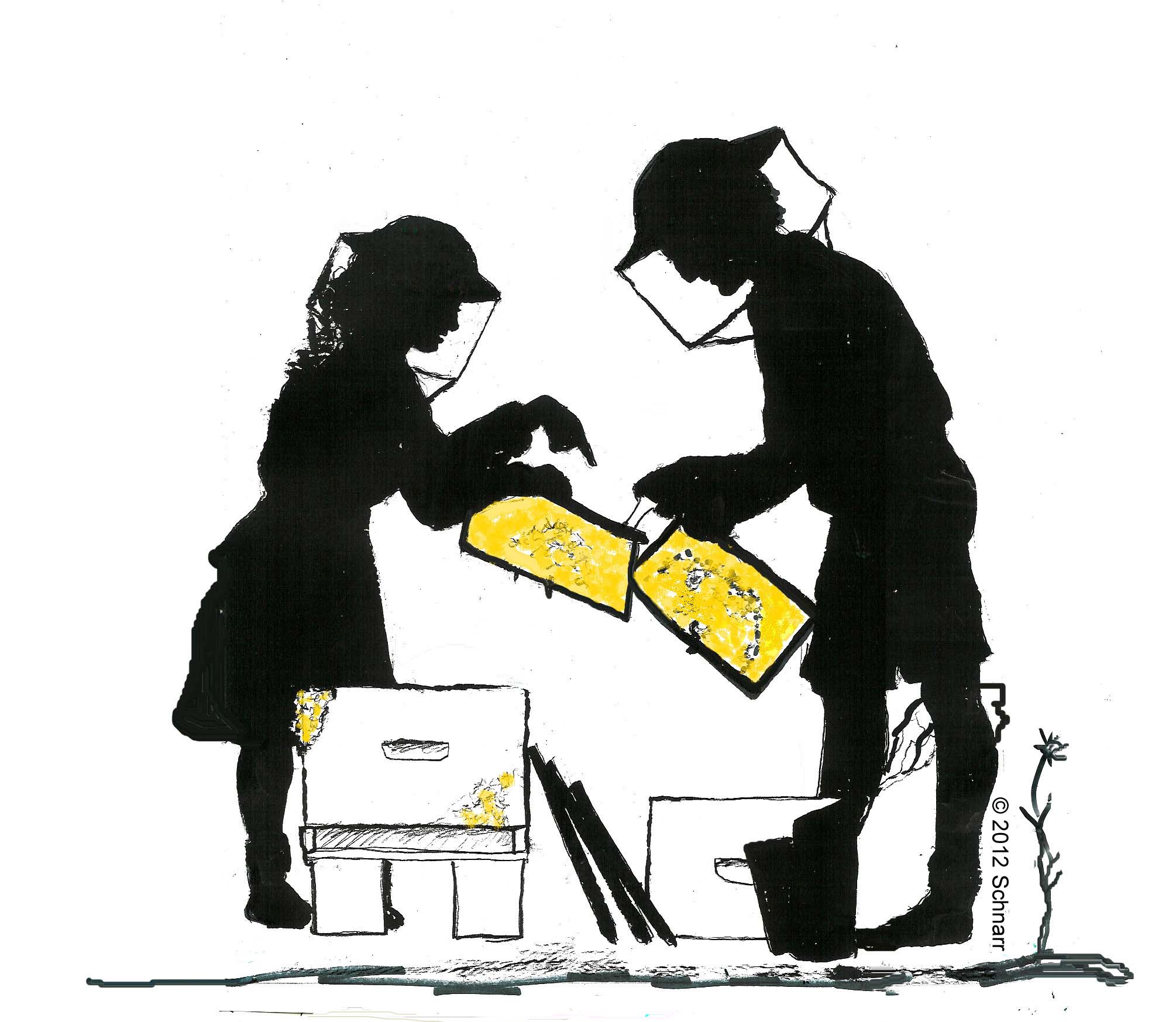
Friday, January 16, 2015
Bee Humor
Tuesday, July 15, 2014
Population Crisis of Honey Bees, Monarchs: Whose next?
An excellent article from the NY Times,"Our Bees, Ourselves", explains succinctly the Honeybee crisis and also what this means possibly for the human race. As the author, Mark Wilson, states, honey bees are a resilient species having survived for over 40 million years and what is effecting them most definitely will impact us.
There are over 120 residues from different pesticides found in honey bee hives which reduce the effectiveness of the bee's immune system and make them more susceptible to disease. Certainly humans are exposed to these residues too and what impact is that having on us?
An the end of the article, he offers a positive note and solution. He sites a recent study which shows that if sizable acreages of cropland are left unspoiled or uncultivated to support wild pollinators, there are higher crop yields and then in turn, higher profits. This concept also overlaps with what we are seeing with the Monarch population crisis and how it is critical to provide wild habitat and protection of milkweed.
Here is the link to the article:
http://www.nytimes.com/2014/07/15/opinion/bees-and-colony-collapse.html?contentCollection=opinion&action=click&module=NextInCollection®ion=Footer&pgtype=article&_r=0
Tuesday, April 22, 2014
Hiveless Spring
The meadow looks so empty:
We moved the apiary from the middle of the meadow to the enclosed blueberry field, just in case there is a change of heart or to be ueber ready for next year.
Some questions emerge:
1. How will the vegetable and flower gardens be impacted with 90,000 more or less fewer honey bees?
2. Will native pollinators fill the pollinating gap again?
3. Will there be more native pollinators with less competition from honey bees and more diversity of them?
4. How will the blueberry plants be effected? Clover?
5. How do honey bees impact native pollinator populations, initially and then over time?
Friday, September 27, 2013
Pick Your Own
Their website is: http://www.capemayhoneyfarm.com/
As I was leaving, I noticed this funny comic strip lying on the counter. I hope you enjoy:
Wednesday, August 21, 2013
Reblogging: Scientists discover another cause of bee deaths, and it's really bad news
Tuesday, March 19, 2013
March Madness
Sunday, July 8, 2012
Plants bees love.
Sunday, May 27, 2012
New Bees, New Breeds!
There are approximately 6 basic bee stocks in the United States and include: Russian, German, Italian, Buckfast, Caucasian, and Carniolan. These stocks are defined by a loose combination of traits such as temperament, disease resistance and productivity and are divided by species, race, region, population or breeding line.
The Weaver All American is an Italian bee that they have been improving for over 85 years. According to their website, these bees are gentle and easy to handle, have quick build-up, low swarming tendencies and excellent producers of honey. They are clean, adapt to all climatic conditions, and breed readily with other types.
The Buckfast bee, largely from the Italian race, was bred by a monk at the Buckfast Abby in Devon, England in the 1920s, to withstand the endoparasitic tracheal mite, Acarapis woodi. These bees are good housekeepers, have excellent grooming behavior which helps reduce disease and produce good honey crops. If not tended regularly though, they can become quite defensive. They are well adaptive to cold winters and breed well with others. According to Weaver Apiaries and a 2 year test of 6 stocks of bees at the University of Minnesota, Buckfast bees ranked as follows:
| Nosema in Queens - none | |
| Acceptance - BEST (100%) | |
| Spring Buildup - BEST | |
| Gentleness - very gentle (second just behind Midnites) | |
| Swarming Tendency - very low (ranked second) | |
| Propolizing - slight (All Buckfast colonies) | |
| Longevity of Queens - TIED FOR BEST (87% after 16 months) | |
| Wintering - TIED FOR BEST | |
| HONEY PRODUCTION - BEST (during two years) For more detailed information and excellent charts, summarizing this information, see the following sites: http://www.beesource.com/resources/usda/the-different-types-of-honey-bees/ http://www.cals.ncsu.edu/entomology/apiculture/pdfs/1.12%20copy.pdf |
Tuesday, May 8, 2012
Bee Happy!
We are still awaiting our northern bred bee packages from Draper.
Our new girls from the south are finally settling in though. We will have 4 hives total - Hive A already lost a queen and we have since re-queened and we found this weekend some laying. Hive B is doing excellent as we have already added the 2nd hive body and she is laying beautiful sheets of brood and they are starting to create lovely honey arcs on each frame. We will have to keep a close eye on this hive to ensure space and discourage any swarming.
This year's spring was so early but now has been just meandering with temperatures in the 50s and 60s, cloudy with intermittent rain allowing for perhaps a a prolonged nectar run?
Saturday, March 3, 2012
Late Winter Beekeeper Report
After 3 years of beekeeping and even a mild winter, we lost our 3 hives. After closely examining the hives for clues of why, we have determined it was not from Chalkbrood or Foulbrood nor starvation as there was eventually plenty of honey stores.
Earlier on, after a very wet and stormy fall, we were concerned the bees didn't have enough honey stores so we gave them heavy sugar syrup into November and probably caused Chilled Brood. The hives looked strong in late July but they started to look weaker as the fall went on.
One culprit is probably mites even though we did treat for mites starting in July with Apiguard. For Nosema we used Fumagillin adding it to their heavy sugar starting October 24th. Perhaps, this was too late considering we had snow on Oct. 29th. To address this for the coming year, we will be giving them winter patties and perhaps trying winter menthol-oil treatments, but we need to research this more.
Honestly, we are glad one of the hives died as it was very aggressive and never produced honey and we tried to re-queen with no success. The hive that produced over 100 lbs of honey last year will be very much missed though.
We have ordered 2 Italian bees packages coming from Georgia being delivered by Jim Bobb at his farm, Worcester Honey Farm on March 31st. (http://www.pabeekeeper.com/) Our first classes for Beekeeping were led by Jim and we have bought from him for the last 3 years and have appreciated all his advice and help along the way.
We would like to experiment with Northern bred bees this year to see if we have more success, so we ordered one package of Buckfast and one package of All American from Draper's Super Bee Apiary (http://www.draperbee.com/beesupplies/Package_Bee_Prices.htm) to be mailed to us in late April.
We will keep you posted.
Sunday, December 18, 2011
Bee cartoons!
Thursday, December 8, 2011
Save the Bees!
On Friday, December 9th, at his elementary school, they have a holiday shop, where the children can come and purchase reasonably priced gifts for their parents, friends and siblings and he and his mother have invited me to participate. Cameron and his friend, Lidia, have made amazing bee crafts too, including bee necklaces, bee headbands and bee ornaments and Lidia will offer bee nails.
They also created an amazing information board as they are more concerned with getting the word out about saving bees and other pollinators than making money!
Stay posted for more information about how to save the bees!
Wednesday, August 10, 2011
Sweet Clover Honey!
We have 3 hives this year and they are vibrant but we are working hard to keep the mites and beetles at bay. We plan to add a 4th hive next year. The hive to the far left has been odd - just collecting honey for themselves and not putting any honey in the honey super for us and they spend a lot of time just hanging out as you can see. The hive to the far right was amazing and is the one from which we collected the most honey.
Friday, January 14, 2011
A Great Day to Fly!
Monday, September 20, 2010
Goldenrod is all the buzz!
The golden rod is blooming and the nectar is flowing, despite the 4+ weeks of drought we have been experiencing. The hive we gathered over 100 lbs of honey from is weakening with the queen laying irregularly and several frames are empty. We rotated the emptier hive box to the top. There was concern of disease with a few brownish larvae but thanks to Brian Marcy he determined the hive is fine and just needs to be re-queened. We continue to administer Tetra-Bee Mix from Dadant to be safe. Both hives are creating honey at a good pace in preparation for the winter.
Wednesday, September 1, 2010
Sugar Woes!

In between nectar flows bees are fed sugar water, heavy or light, depending on the time of year. For our 2 hives we use 5 lbs a week. When purchasing sugar recently I noticed that the bag seemed lighter – and IT WAS! Not 5 lbs but 4 lbs and for the same price!! That is a 20% price increase for a beekeeper and also something to take note of when preparing the sugar water mixtures. It takes 10 cups of water to 5 lbs and only 8 cups to 4 lbs when making a light sugar water used during the warm months! Most shoppers might not notice this but this is something for beekeepers to buzz about.
Tuesday, July 13, 2010
Mid-Summer Bee Report , 2nd of July
Regarding the weak hive, we had killed the second queen as she too was not laying and had added the hive body to the top of the strong hive to keep mice at bay. We returned it to the original platform before we removed the honey supers keeping in mind that it only takes bees 45 minutes to realize they do not have a queen. Later in the day we added a nuc to the weak hive which we purchased from Mark Antunes and has a ton of bees and a queen that lays beautifully. To add the nuc we did the following: On top of the original hive body, we placed a queen excluder and then a sheet of newspaper with a few slates cut into it and then added a hive body we had been saving in the freezer that still had built out frames, some even filled with honey. We removed 5 frames and then added the nuc which is basically a mini hive with 5 frames of brood and a queen. We added 2 jars of light sugar water and hope we can get this hive in good shape before the winter. We returned a few days later to remove the queen excluder and newspaper and hope that they have happily become acquainted with one another.
Thursday, June 17, 2010
How Sweet It Is!
It has been awhile since I shared some bee adventures. Starting in early April we observed our strong hive working hard and creating some queen cells. We were concerned with swarming and kept an eye on things. The queen was laying well and the hive was booming. Near the end of April, we decided instead of splitting the hive we would add some honey supers as we noticed they were making honey in the brood chambers. On May 22nd we harvested over 50 lbs of honey. We used a fume board and bee quick spray and it worked like a charm pushing the bees below. The honey is light and sweet. We have the honey supers back on and will extract probably another 40-50 lbs in about 2 weeks, after the nectar flow comes to an end.
Regarding the photo, the jar to the left is our honey from last year, which we extracted in mid July.
Wednesday, April 7, 2010
Down by the stream
The swamp or skunk cabbage (Symplocarpus foetidus) emerged a couple of weeks ago down at the stream. I had read that it provides one of the earliest sources of pollen in the spring and I was curious if my bees were taking part. Upon closer scrutiny I indeed found many bees flying in, crawling deep into the dark purplish curled hood and then off again to the hive to store the pollen. The foul odor attracts the bees and inside they may find a cozy temperature reaching into the 80's. After knee deep in mud and patiently awaiting for a bee to emerge, I captured this great shot. If you click on the picture, you can see the bee at the tip.
Sunday, February 21, 2010
Winter Blues
At last we have a bit warmer weather. There is still at least 8 inches of snow on the ground but the sun feels warm, the temperature is around 40 degrees and there is an approximate 15 mph wind out of the NW. We spot a flock of bluebirds in the meadow and 2 red tailed hawks swirl past.
It is finally warm enough to take a quick peek at our bees. We trudge through the snow following what looks like a fox trail through the snow that leads directly to the hives. A couple of bees greet us from the stronger hive. They haven’t touched much of the fondant we gave them months ago, there is a large bundle of bees near the top of the second hive body and they are milling around slowly, probably dazed by the sun and cool wind. After closing that hive, we head to the second hive, where it is very quiet. We find that they are all dead. There is no honey to be found and they must have starved. We are silent and sad. They originally were our stronger hive from which we collected over 30 lbs of honey in the spring. In the fall though we noticed their numbers were decreasing and they had not collected as much honey. They will be missed.
Picture from this site: http://www.motherearthnews.com/uploadedImages/articles/online_articles/2008-01-01/WinterBlues.Car.Web.jpg