Showing posts with label winter. Show all posts

Wednesday, May 16, 2018

2018 - Year of the Bird: Our amazing sightings, Part I


Between the winter storms, there were many wonderful beautiful bird sightings.


To end 2017 on a very cold December 31, at the feeder there were northern cardinals, a Hairy woodpecker, juncos, house finch, titmice and on the spruce by the window, a white throated sparrow:


Also, that afternoon, a large flock of Cedar waxwings descended on our Winterberry bushes.


On January 4th, during one of our icy snow storms, the Serviceberry tree was adorned with brillant male Northern cardinals with a couple of females in tow as well as some Tufted titmice and Blue jays.


Late in the morning on a clear 50 degree January 20th, a small group of Sandhill Cranes flew in and milled about the meadow looking for food for a few hours. It was a rare sighting and they lingered in the area for weeks. We were fortunate to see them up close and personal.


March brought 3 major winter storms and weeks in between of very cold and dreary weather. During that time, a pair of bluebirds regularly used the bird feeder, often with the male holding watch, as the female ate. A White breasted nuthatch also can be seen here on March 28th!


A small deer carcass lay in the side meadow and was found quickly by our local vultures, who fed on it for days as well as by the resident fox on April 3rd.


After the Northeasters, spring winds brought our first ever seen here Eastern phoebes on April 7 in the late afternoon. They caught my attention, as they were flying actively around the deer in the lower meadow, who were kicking up some flying insects. They were diving in and around the deer, who were also curious about them, approaching them to smell them. 


A couple of days later, a pileated woodpecker was seen on a fallen willow tree stump down by the stream.

With warmer temperatures in May, trees are finally bursting with leaves, flowers are blooming, insects are emerging and migratory birds are moving north. Returning back after a long walk, Lilli caught sight of a squirrel which gave me pause to notice a very red bird flying back and forth above me next to the vernal pond. At first glance, I thought it was a Northern cardinal, but then quickly noticed that it had black wings - a Scarlet tanager! I thought he was just hoping back and forth, curious about me, but more likely he was trying to get the attention of a nearby female.


I have binoculars ready and looking forward to seeing more exciting birds, 
this Year of the Bird!


Thursday, June 1, 2017

Deer Paparazzi

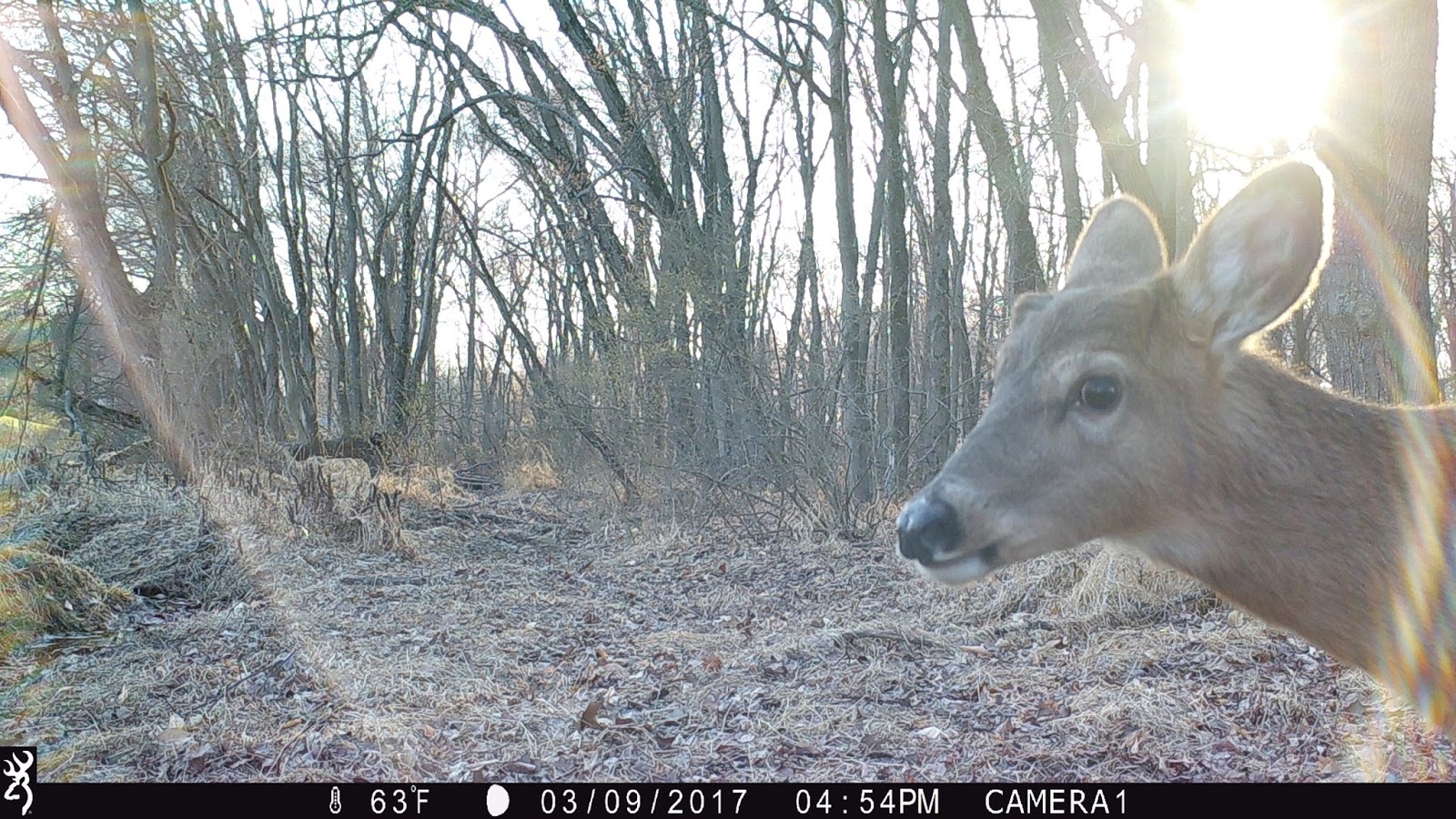
We have many deer on our property every day, sometimes as many as 25. 

Using my new trail camera, of course, most of the photos are of deer, but this series is my favorite, shot by the creek in the lower meadow during sunset.

This female is so curious and stops to check it out. 


 I love how she circles back around to investigate further. 


 Maybe if she sniffs it, she can figure out what it is.


and that night, look who goes whizzing by:


Monday, May 29, 2017

Winter Fox

For Valentine's Day, a long time wish was realized: 
a Browning Trail Camera 
with night video and photo capability. 

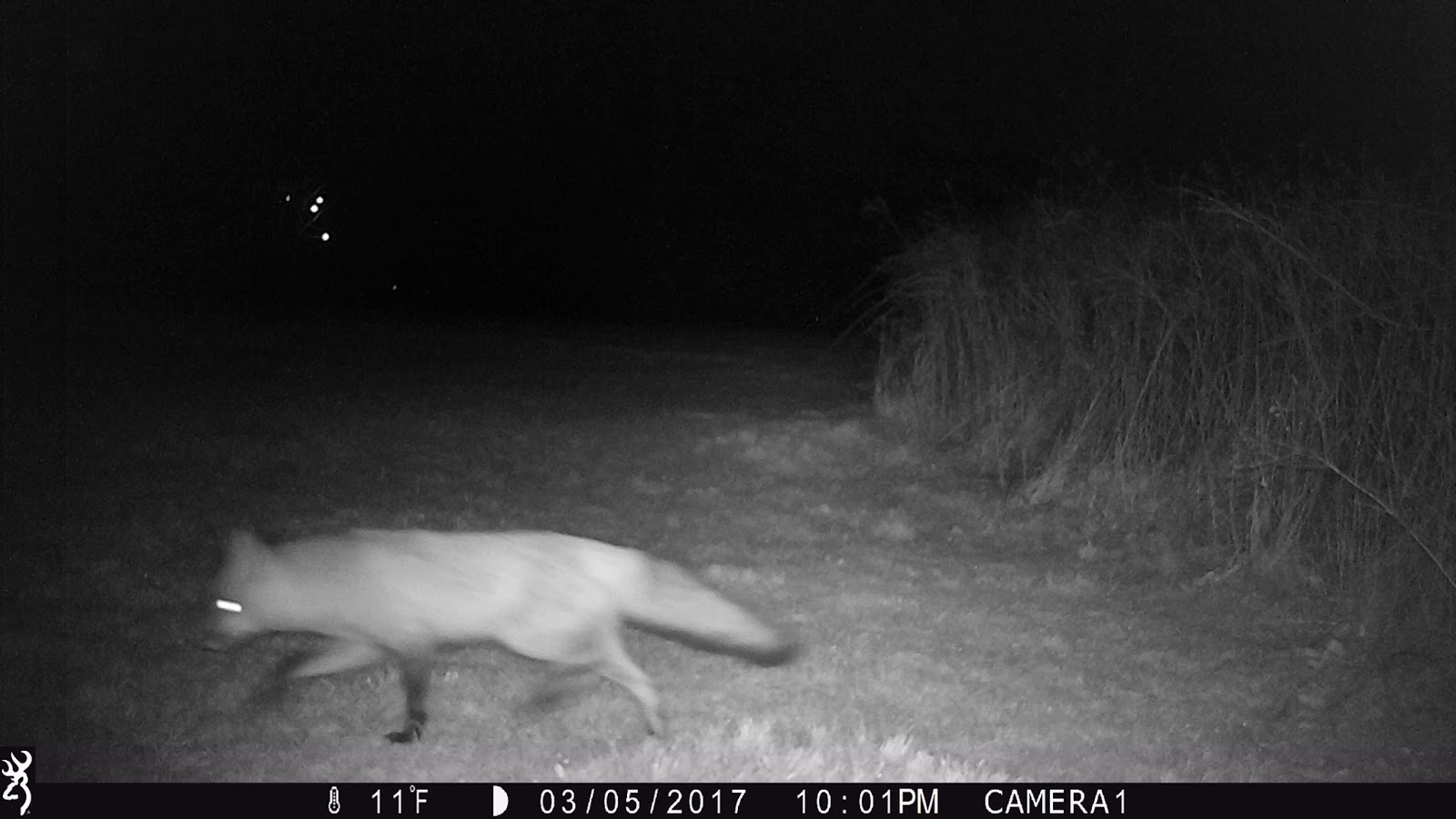
I was surprised to see all the fox action at all hours this past winter. 

I positioned the camera on a cherry tree, located at the lower meadow on March 5th.
It's around midnight and only 5 degrees. 


I repositioned the camera on the opposite side of the same tree, to see if I could capture the fox coming towards the camera and I did. The camera must make a noise or project a light to startle the animals each time.

Here is the fox around 7 p.m and 20 degrees out. He comes shooting by again at 10 p.m. and now 11 degrees out.


I was curious if there were fox hunting in the upper meadow, too. I caught a glimpse of this one during the day, headed up the middle path on a cold, sunny day on March 11.


A couple of weeks later, a fox trotted by near the upper meadow during a snow storm at 3 a.m. and 22 degrees out. 


With all this fox action, I was curious if it was a female and with a den near by. 

I never did find one. 

Tuesday, February 9, 2016

Winter Storm Jonas

Starting late January 22 and through the evening of the 23rd, we were hammered with wind and lots and lots of snow - over 30" in just 24 hours. The largest snow fall the area has seen in over 20 years. Surprisingly, there were no power outages in our area.

Here are some photos to mark the event:


Birds took shelter in the nearby trees and grabbed a bite to eat.


It was a quick moving storm and followed
by brilliant sunshine and blue skies for days afterwards. 


Saturday, February 6, 2016

Winter Tree Portraits

A true joy of winter is the observing of trees 
and their beautiful 
varied shapes and structures. 

Their bones.  

Their skeletons.

A foggy evening made for 
a perfect backdrop 
for these tree portraits. 

Maple (Acer)

River Birch (Betula nigra)

Sweet Gum (Liquidambar)

Dawn Redwood (Metasequoia glyptostroboides)

Sunday, January 24, 2016

Winter Buffet

During the winter, birds struggle to find food, shelter and water. You can help by planting a variety of plants, shrubs, vines, grasses and trees that provide berries, seeds and nuts for them throughout the winter. These plants provide not only food rich in calories, nutrients and antioxidants for the birds, but also, beauty, texture and interest for you, as well.

Here are some to consider:

Shrubs:
1. Viburnums such as Cranberry Viburnum (Viburnum trilobum)
2. Staghorn sumac (Rhea typhina)
3. Northern Bayberry (Myrica pensylvanica)
4. Native roses
5. Winterberry (Ilex verticilatta)

Vines:
1. Virginia Creeper (Parthenocissus quinquefolia)

Trees:
1. Oaks (Quercus)
2. Walnut (Juglans)
3. Hickory (Carya)
4. Eastern Red Cedar (Juniperus virginiana)
5. Spruces (Picea)
6. Juniper (Juniperus)
7. Dogwood (Cornus)
8. Holly (Ilex)
9. Hawthorn (Crataegus)

The Green Hawthorn, Winter King,  is a beautiful, pyramid shaped, small tree with small thorns, which has beautiful white flowers in the spring, brilliant red purplish leaves in the autumn and scarlet berries in the winter. 

I have a Green Hawthorn right outside my window, which makes for easy viewing and photographing. In the course of just a couple of hours, I captured 6 different bird species feeding. 

In order for the berries to become soft and edible, they need to go through a few freeze-thaw cycles. 

Here is a robin gobbling down a berry:


A female northern cardinal is finding an abundance of berries on the ground: 


A dark-eyed junco rests and takes shelter after a satisfying meal:


 This cedar waxwing flew in briefly. I hope he tells his friends.


On a neighboring pear tree, a red-bellied woodpecker peeks at all the activity:


The resident blue birds are seen daily on this tree,


including these 2 juvenile blue birds, who stopped by to check out all the commotion:


Another blue bird dives in to partake:


A large flock of robins have lingered for over a week, enjoying the feast daily:


To check which plants are best suited for your area, this website can provide the answers
you need, organized by plant or by state:
http://plants.usda.gov/checklist.html

Sunday, October 25, 2015

Protect Your Living Soil for the Winter!

After attending a seminar titled, The Down and Dirty: Soil Building Secrets for Greener Gardens by Elizabeth Murphy of Oregon, who has recently published a book called: Building Soil: A Down to Earth Approach, I decided to reevaluate how I put my gardens to bed for the winter.  

I liked how she explained, that soil is a collection of living organisms that comprise the first few inches of soil and need to be cared for like any organism. It has the same basic needs including: water, food, air and shelter/space. During the winter, soil and its organisms need to be protected from exposure and erosion.

I was inspired to try another way to care for my garden soil during the winter. In the past, I have tried a cover crop such as buckwheat, which she advocates for, but I found it unwieldy to deal with in the spring. I tried covering it with black plastic and was fairly satisfied with this approach, but there are no added nutrients with this method. However, there were fewer weeds and the soil was protected. 

Instead of taking all the spent and dead plants and the nutrients that they embody out of the garden in the fall and taking them to the compost pile, why not leave them in place and compose them there directly. So, with my cutting flower bed, I have left the zinnias in place. The birds, overwintering or who haven't left on migration, have continued to feast on the left-over seeds. This will protect the soil from wind and rain, and the blowing or washing away of all the nutrients or compacting by pounding rains or snow.


I have covered another bed with black plastic for comparison sake. I was surprised to see who was sneaking about. Note the large turkey prints!


She has lots of great ideas, including fall cover crops such as clover and using cardboard, 
all ideas I would like to try next fall. 

Here is a story well worth reading: 

Here is a link to her blog: