Showing posts with label robins. Show all posts

Thursday, July 20, 2017

Robin's Second Brood

It was late May, when I first noticed the robin darting back and forth by the window to the holly tree. After watching more closely, I noticed a nest. 

It was a bit high to reach easily and I just made note of it.


Some weeks have passed and I see again, that the robin is still hanging around, 
now at the viburnum bush, just 20 feet from the first nest over the fence.


I peek through it's branches and discover, that indeed, there is another robin's nest.
I grab a ladder to get a better look, as it's only 5 feet off the ground this time. 


I catch the mother straining her neck to see what I'm doing, as she digs around for worms in the mulch nearby. 


 I pull the branch towards me and 
there, there is the baby. 
Just one, flattened deep into the nest, 
with just one tiny eye watching me. 


I wait a long while for the mother to return, 


and there she is, with a big wormy meal for the baby. She wrinkles up her head feathers, 
not pleased to see me still watching.  


I retreat, satisfied with some good shots to share.


Sunday, May 1, 2016

Eggs of Blue

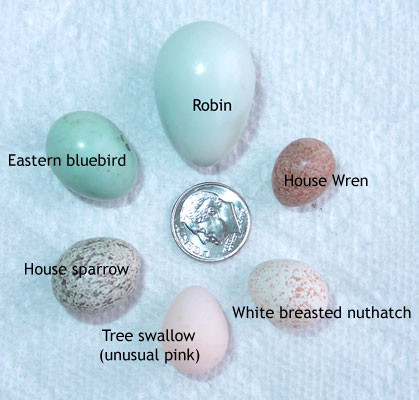
Along the driveway, there were 2 small, broken, very blue eggs.


Why? Why along the driveway? 

Was the robbing bird using the hard surface to help break the eggs? 

Why not just use their pointy beak?

Whose eggs were these? 

They seemed smaller than a robins?

Which other birds lay blue eggs with no markings or spots and are smooth?

Using Peterson's Field Guide: Eastern Bird's Nest, this is what I found:

From small to large:
14 x 11 mm - blue-gray gnatcatcher -  pale - bluish, bluish white
18 x 13 mm - house finch - pale bluish green
20 x 16 mm - bluebird - pale blue, bluish white
22 x 16 mm - veery - pale blue, similar to robins
22 x 16 mm - hermit thrush - very pale blue
23 x 17 mm - gray catbird -  deep greenish blue
25 x 18 mm - wood thrush - pale blue
28 x 20 mm - robin - robin egg's blue
29 x 21 mm - common starling - pale bluish or greenish white


Here is an online site for egg and nest identification:
http://thebirdersreport.com/egg-and-nest-identification

In measuring the egg, it is around 28 mm and with it's distinct blue, it's most likely a robin's egg.


Tuesday, February 9, 2016

Winter Storm Jonas

Starting late January 22 and through the evening of the 23rd, we were hammered with wind and lots and lots of snow - over 30" in just 24 hours. The largest snow fall the area has seen in over 20 years. Surprisingly, there were no power outages in our area.

Here are some photos to mark the event:


Birds took shelter in the nearby trees and grabbed a bite to eat.


It was a quick moving storm and followed
by brilliant sunshine and blue skies for days afterwards. 


Sunday, January 24, 2016

Winter Buffet

During the winter, birds struggle to find food, shelter and water. You can help by planting a variety of plants, shrubs, vines, grasses and trees that provide berries, seeds and nuts for them throughout the winter. These plants provide not only food rich in calories, nutrients and antioxidants for the birds, but also, beauty, texture and interest for you, as well.

Here are some to consider:

Shrubs:
1. Viburnums such as Cranberry Viburnum (Viburnum trilobum)
2. Staghorn sumac (Rhea typhina)
3. Northern Bayberry (Myrica pensylvanica)
4. Native roses
5. Winterberry (Ilex verticilatta)

Vines:
1. Virginia Creeper (Parthenocissus quinquefolia)

Trees:
1. Oaks (Quercus)
2. Walnut (Juglans)
3. Hickory (Carya)
4. Eastern Red Cedar (Juniperus virginiana)
5. Spruces (Picea)
6. Juniper (Juniperus)
7. Dogwood (Cornus)
8. Holly (Ilex)
9. Hawthorn (Crataegus)

The Green Hawthorn, Winter King,  is a beautiful, pyramid shaped, small tree with small thorns, which has beautiful white flowers in the spring, brilliant red purplish leaves in the autumn and scarlet berries in the winter. 

I have a Green Hawthorn right outside my window, which makes for easy viewing and photographing. In the course of just a couple of hours, I captured 6 different bird species feeding. 

In order for the berries to become soft and edible, they need to go through a few freeze-thaw cycles. 

Here is a robin gobbling down a berry:


A female northern cardinal is finding an abundance of berries on the ground: 


A dark-eyed junco rests and takes shelter after a satisfying meal:


 This cedar waxwing flew in briefly. I hope he tells his friends.


On a neighboring pear tree, a red-bellied woodpecker peeks at all the activity:


The resident blue birds are seen daily on this tree,


including these 2 juvenile blue birds, who stopped by to check out all the commotion:


Another blue bird dives in to partake:


A large flock of robins have lingered for over a week, enjoying the feast daily:


To check which plants are best suited for your area, this website can provide the answers
you need, organized by plant or by state:
http://plants.usda.gov/checklist.html

Sunday, June 7, 2015

Who's at the Window?

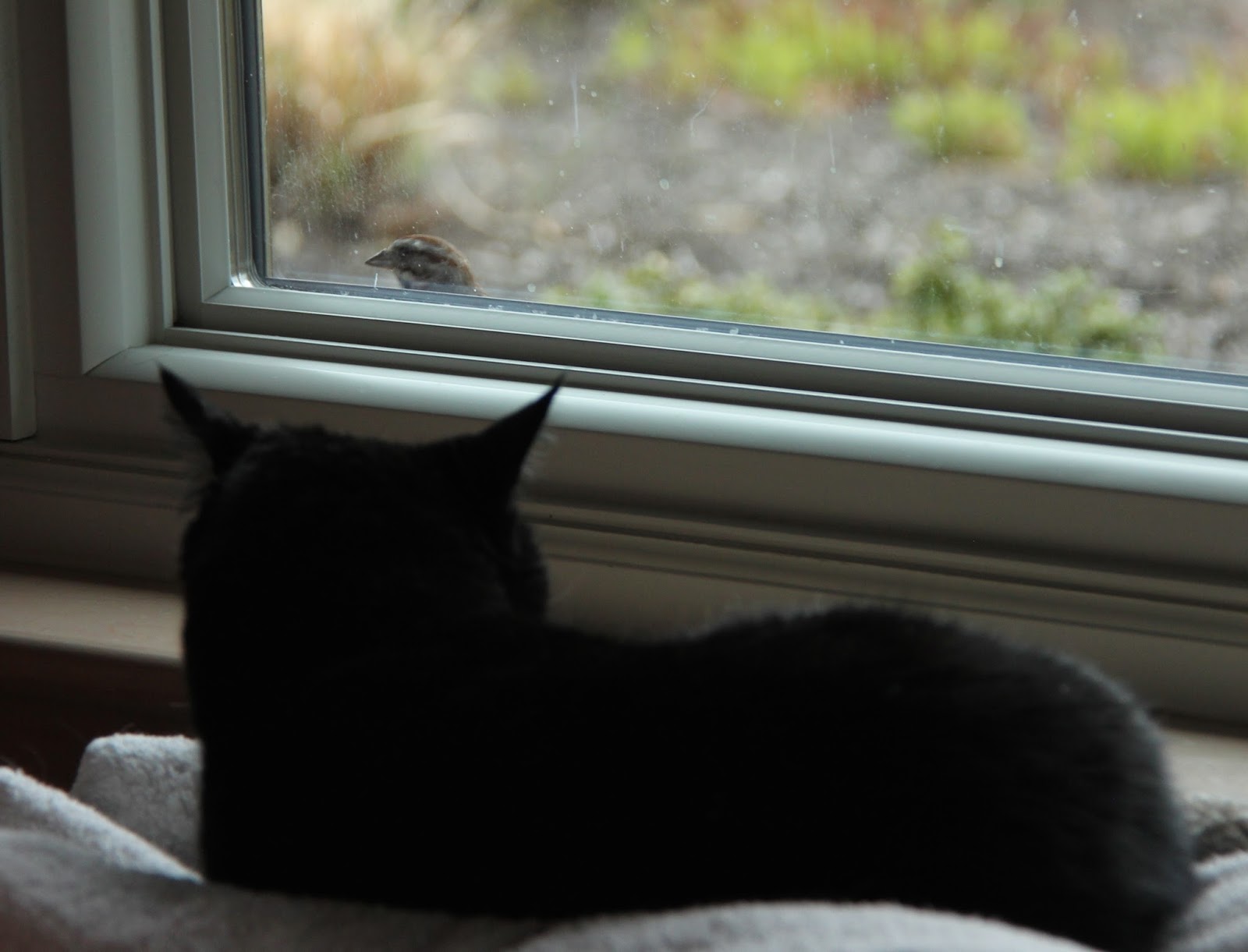
This year's window tapper is a Song sparrow. 
Can you spot him in the window? 


He is quite persistent, 
but I have enjoyed his beautiful song, when he 
perches high in the adjacent 
Holly or Japanese Maple, 
as pictured here:


He certainly battles his reflection nemesis, but can also see inside too, 
as he peers 
curiously at Latte cat 
here:


We have had battling crows and robins too. Other curious peekers have included 
a frequent squirrel:


and today, a doe:


Our windows are tinted and reflective. Birds, even animals, in seeing their own reflection, may interpret it as an intruder to their breeding or feeding territory and attack their "Doppelgaenger", trying to chase it away. They will peck furiously, beat at the window with their wings and even claw, exhausting themselves and sometimes even injuring themselves.

Birds you might expect to see exhibiting this behavior include: American goldfinch, American robin, Chipping sparrow, Song sparrow, Northern cardinal, Northern mockingbird, Eastern towhee, etc.

Here are some suggestions I have used or found on other sites to discourage this behavior:

1. Set up a bobbing headed bird of prey, such as this owl, from Home Depot:
2. Consider soaping the window
3. Put up a physical barrier such as netting or a screen
4. Put, lean or hang branches or distracting objects by the window 
5. Attach adhesive silhouettes of bird of preys or any bird:


6. Keep the curtains closed, which might help reduce the reflection.

These sites offer more information: 

It has been a week now, the pecking has stopped and the Song sparrow has moved on. Typically, pecking will end after breeding season has passed. 


Tuesday, December 11, 2012

Hidden Treasure Found

After 3 trips for bows to decorate the fence, finally I was at the end on this cold, wet, foggy morning.


What to find, but a beautifully constructed robin's nest, which had been hidden all summer by the surrounding woody vines -


Beyond the fence, it is delightful to see in bloom on this dreary day, Purple Beautyberry (Callicarpa dichotoma)


Around the corner, I re-discovered the old bird house in need of repair or replacement, which the blue birds used all summer


and above appeared suddenly in the thick fog, geese in formation, preceded by their calls -


Thursday, February 9, 2012

Feasting Robins and Cedar Waxwings

A couple of weeks ago, our Green Hawthorne was overflowing with red berries. Not for long! A flock of robins flew in, flying back and forth between a maple and seemingly taking turns in feasting.


Within an hour, a tightly oval shaped flock of Cedar Waxwings joined them. These medium sized birds have a silky appearance,  have yellow-tipped tails and striking black markings on their faces. They eat insects during breeding season and berries especially from Junipers year round. They are know to pass berries from bird to bird which is believed to help in the digestion of the berry. Find more info at this Cornell Birding site : http://www.allaboutbirds.org/guide/Cedar_waxwing/id/ac


Robins and Cedar Waxwings are both very social birds and eat the berries whole and seem to get along quite well, contrary to the report I found online. (http://www.jstor.org/pss/4513265).

Here is an excellent video of these beautiful birds on Youtube:

Friday, January 8, 2010

Winter Feast at the Hawthorne


The yard was amass with various birds this week on a very cold blustery day including robins, starlings, mourning doves, wrens, cardinals and red bellied woodpeckers. The temperatures have been persistently in the 20s and 30s with windy conditions since before Christmas. 

A flock of at least 30 robins were feasting excitedly on the ‘Winter King’ Green Hawthorne (Crataegus viridis L.) tree’s brilliant red berries. There was another flock of starlings searching for errant seeds or morsels in the side yard. They suddenly flew into formation though as a red tailed hawk soared over. 

The berries are too hard in the fall for the birds to eat, but soften, perhaps even ripen after being frozen and then edible for the over-wintering birds and other animals. 

The Green Hawthorn is one of my favorite native trees, as it has beautiful silvery grey bark which defoliates as it grows, revealing an inner orange bark. It has delicate white flowers in the spring and its' dark green foliage turns bronze and gold in the fall. Finally, in the winter it is bedecked with these lovely large red berries, which hang like miniature ornaments until the birds arrive and have their feast.