Showing posts with label house sparrow. Show all posts

Sunday, February 12, 2017

Birdhouses Closed for Business

Before the birds begin making their selection for new birdhouses for the season, we chose this grey, cold, wet day to get the houses cleaned out.


Some interesting finds and observations included:

> One nest had a prominent blue jay feather featured, although it hadn't been used by one:


> Three plumb mice promptly jumped out as we removed the thick nesting material, jumping wildly into the air, practically onto us, but landed in the snow below and scurried away:


Another house, at the top of the property and usually used by bluebirds, had a small, very messy, loosely built nest made of small twigs and moss. It looked like it must have been very uncomfortable for baby birds:


We have never seen this type of nesting materials in this birdhouse before. Perhaps, it was a Carolina Wren's, Northern Mockingbird's, or Great Crested Flycatcher's nest? 

Northern mockingbird nests are composed of a lot of twigs, and seem to resemble the nest we found the best.

(Photo: http://4.bp.blogspot.com/)

As we made our way back to the meadows, we flushed out a very wet Coppers Hawk, who routinely can be seen here, by the vernal pond:


The newest birdhouse hasn't been used recently and was completely free of bird nesting material:


The birdhouses will all be left wide open this year to hopefully break the cycle of house sparrows using them.


Every bird is on their own for the nesting season this year!

Monday, July 4, 2016

Carpenter Bees, Blueberries and Catbirds

In early spring, a queen Carpenter bee took up residence right next to our blueberry field. 
See the hole on the post to the right:


She regularly worked the blueberry blossoms, pollinating them, one by one, day by day. 
This helped ensure fully developed fruit.

She attempted to make additional homes in the poles, as you can see here, with her flying around, checking out different locations,  


and then actively chewing on the wood.


This is what her home looks like inside the post:

After mating, the female will burrow like this into untreated wood and lay eggs in a series of cells, providing balls of pollen for the larvae to feed on. The adults emerge in late summer.

(https://entomology.ca.uky.edu)

Four of the 14 bushes were netted to keep the birds out.


The 6' foot bushes were ladened with fruit this year, thanks to the excellent pollination by the Carpenter bee. These bees are also important pollinators for eggplants and tomatoes. 

Carpenter bees are the largest native pollinators in the US. 
They emerge in early spring and work early in the morning until late in the evening. 
They have a medium length tongue, are sturdy, with a hairy thorax and a shiny black abdomen. 
These bees can travel up to a mile. 

(See a previous blog entry on March 12, 2012)


Every day, at least 2 - 4 Catbirds found their way into the netted enclosure. 
This has gone on for 2 weeks. I went out twice a day to check and let them out, where they then dashed back into the thicket, turning to meow, squeak or squawk at me.

It was always Catbirds! 

Gray Catbirds especially love blueberries and other fruit. 
They are mimics repeating a variety of sounds and can sing a song for up to 10 minutes.


Here is the first bowl. 


Yesterday afternoon, I went out and found 5 Catbirds in the enclosure and decided to go ahead, take down the netting and pick all the berries. 

After picking over 2 hours, 
the total collection came to 19 pounds or 27 pints.

There were still lots of berries left on the bushes and as I came out to the field today, I found over 10 birds feasting, including Thrashers, Robins, Sparrows and 
Catbirds, of course!

Thursday, May 5, 2016

Beware of Aggressive House Sparrows!

The Tree Swallows have been hunting insects in the meadow, swirling overhead and then off into the nesting box. Great news! They must have a nest!

But, wait, a House Sparrow followed it into the nesting box?

Did I see this correctly? What was going on? I dashed inside and did a quick search of Tree Swallows versus House Sparrow and this is what I found out:

House Sparrows are over 80,000,000 strong here in the U.S. and counting. Also known as English Sparrows, they were introduced from Great Britain 150 years ago and they are NOT a native bird. They are extremely aggressive and will corner Tree Swallows, Blue Birds, and other native birds, who they are competing with, following them into a nesting box and pecking them to death. Yikes!

This is the picture shown on the site listed below:


http://www.treeswallowprojects.com/spardam.html

Shocked and disturbed, I raced to the nesting box to investigate. I found 5 baby House Sparrow inside, which I left in place and they are thriving. I was relieved not to find a dead Tree Swallow.


What was going on in the rest of the nesting boxes? These are nesting boxes that had been erected specifically to help the Blue Bird population in the area!

The nesting box by the fence, historically, always a Blue Bird nesting box, had House Sparrows and 4 eggs. Out that nest came! The Blue Birds had been over wintering in this box all winter and had clearly been chased off.


In the upper meadow, 2 of the nesting boxes housed House Sparrow nests. Out they came. The middle nesting box have a Blue Bird family nesting and they were already being harassed by House Sparrows.

What to do? The site above offers some great suggestions, which I will pursue, including a Sparrow Spooker and Hironbec Pendulum.

Here is the site to access this information: http://www.hironbec.com/ENbicolorefiche.htm

Another outstanding site offers further suggestions on how to deal with this serious problem:
http://www.sialis.org/hosp.htm

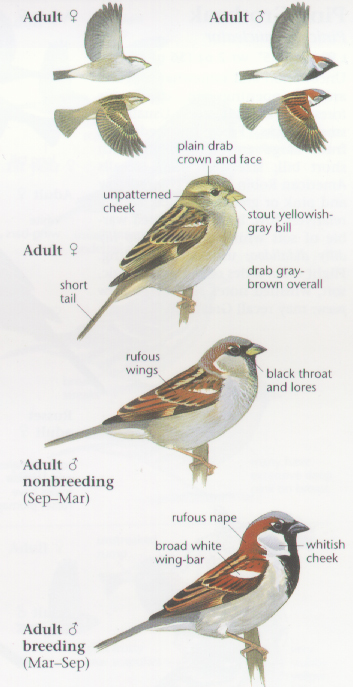
Before acting, be sure to make a correct ID:


http://www.swartzentrover.com/cotor/Photos/Hiking/Birds/BirdPages/HouseSparrow.jpg

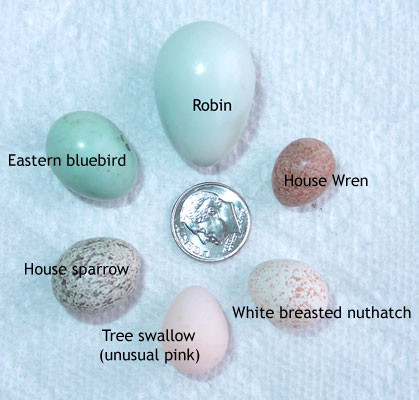
Egg comparisons for making correct ID:


I will continue to monitor these nesting boxes and remove House Sparrow nests every 10-12 days, as recommended.


Thursday, January 22, 2015

Who's coming to dinner?

On dreary and cold Sunday, January 18, with pouring and freezing rain and 27 degrees, we had over 12 different species visit our backyard feeder in just an hour, between 10 and 11:00 a.m. This is even with the main bird feeder not filled.


Here is the breakdown, including visits to the feeder. I've counted visits rather than number of different birds feeding, as it's hard to determine if it's a different bird each time.

Dark-eyed Junco - 13 visits
Song sparrow - 1
Tufted titmouse - 22
House sparrow - 5
Mourning dove - 6
Black-capped chickadee - 4
Carolina wren - 1
White-breasted nuthatch - 4
Northern cardinal - 4
Northern flicker - 1
Downy woodpecker - 2
Red-bellied woodpecker - 3

It definitely is the day for the Tufted titmice, who hung around, eating, even grooming at the feeder. The Juncos spent additional time on the ground feeding throughout the hour. They were not bothered by other visitors. The Woodpeckers came within a few minutes of each other and really filled up. In the hour, only the Tufted titmouse used the squirrel-proof feeder. By in large, the birds don't like feeding from it.