Showing posts with label spiders. Show all posts

Sunday, September 29, 2013

Spiderlandia

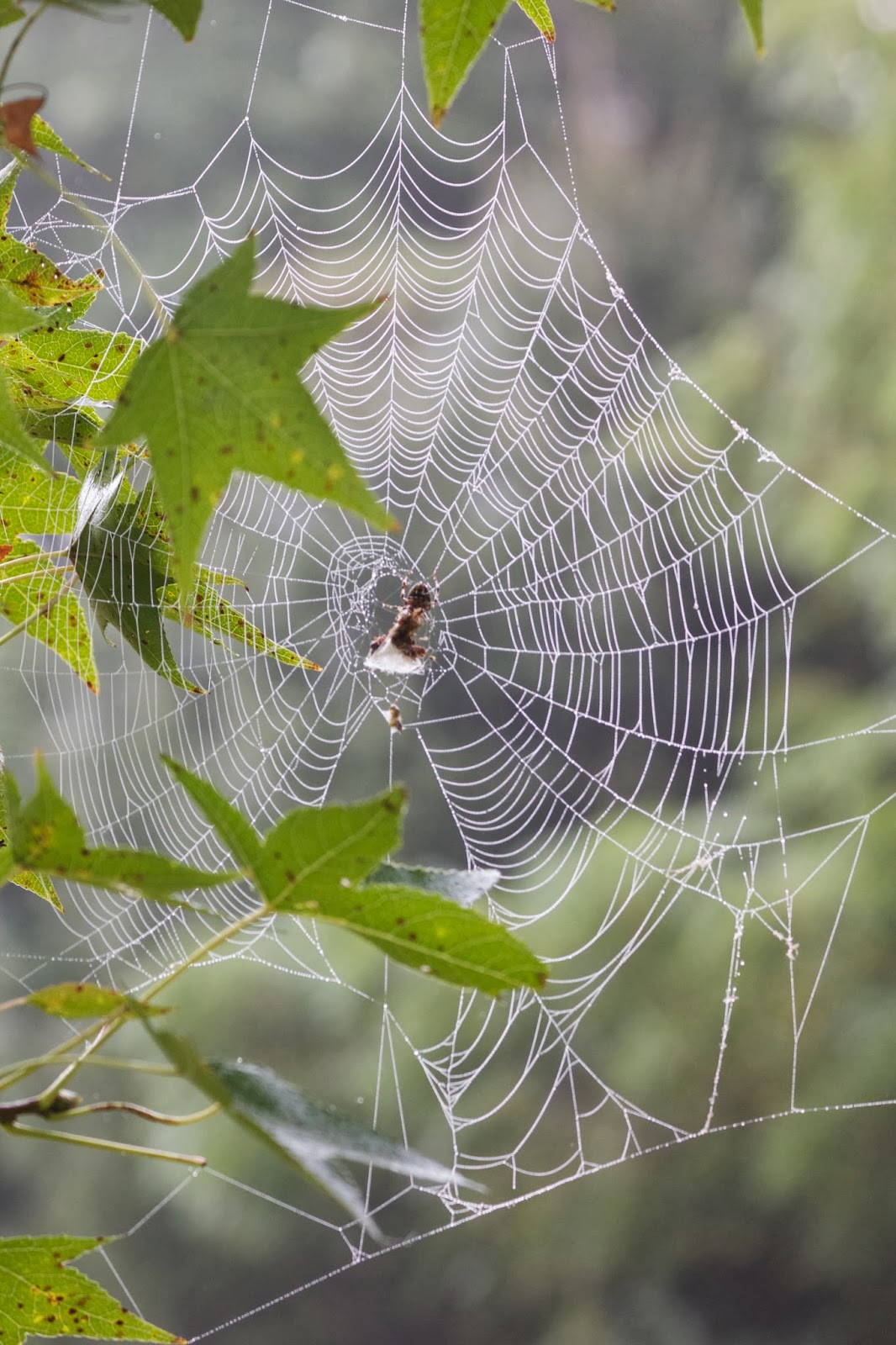
Every September, spiders and spider webs are everywhere to be seen.  Spiders are busy casting webs, catching prey, paralyzing and liquifying them, mating and laying eggs.

On a recent foggy morning, the spiders' night's work was astonishing, with webs of all different sizes, shapes and configurations. This site explains and shows how a web is created:
http://www.spiderzrule.com/spiderweb.htm

Here are some Orb weavers and their amazing, intricate webs:


and Sheet web spiders, including Platform spiders at a greater number than I have ever seen before in the last several years. Within a greater complex of webbing, there is a platform that looks like a parachute.


Here is prey wrapped in silk with the spider located right under it:


Here is another orb weaver in a Sweetgum tree processing its prey:


This article explains clearly the process of the spider injecting its prey with venom, wrapping it in silk and then liquifying: http://science.howstuffworks.com/zoology/insects-arachnids/spider7.htm

According to recent research, spiders can learn how to catch prey more effectively. See articles:
http://rsbl.royalsocietypublishing.org/content/9/4/20130052.short
http://www.livescience.com/34775-spiders-learn-snag-prey.html

Here is a Penn State publication on Spider ID in PA: http://pubs.cas.psu.edu/freepubs/pdfs/uf019.pdf

In search for more information about spiders, I found these interesting and informative blogs:
http://bugeric.blogspot.com/
http://www.spiderzrule.com/

Friday, October 7, 2011

" We'll eat like kings."


This Farside comic came to mind one foggy morning this past August when I discovered several huge spider webs about 2 feet by 3 feet in diameter


dangling from our Sweet gum trees 
and then several along the evergreen path. 


What were the spiders trying to catch? Deer? Me? 
I never found the spiders who cast these webs. Perhaps, that is a good thing so I can sleep at night.
There were also smaller ones in the trees dangling like ornaments in a Christmas tree:


Monday, November 8, 2010

What a line - a dragline, I mean!


About a month ago, I was walking and observed this extremely long spider’s dragline dangling over the driveway. My husband had just drove speedily under it and it was still swaying in the breeze.


It reached from the top of a Sweetgum tree, over the driveway and then to a Norway Spruce, meandered through the branches and then up to the beautiful web, as pictured here. I was amazed, quickly ran home and grabbed a measuring tape and camera. It measured over 20 feet long. I wanted to learn more - how could it still be intact?

A spider makes a new web daily and uses a dragline for making the web's outer rim and spokes as well as for a lifeline. Spider silk, made of proteins, has a tensile strength comparable to high grade steel and is very stretchable and has a high toughness similar to nylon. It is so amazing that labs all over the world are carefully studying its composition and mechanics in hopes of reproducing it someday for human needs. 

Monday, September 27, 2010

Spiders do the dew (wop)!


Recently, on one very humid morning, these mini 'pearl drops' were captured on a web of a grass orb weaver.

Apparently dew can not adhere to human hair but can on dry spider silk. A study published earlier this year in Nature (Zheng, Y. et al. Nature 463, 640-643 (2010) of the hackled orb weaver spider Uloborus walckenaerius web concluded the following:

“Dry spider silk forms a necklace-like structure. Two main fibres support a series of separate rounded 'puffs', each made up of tiny, randomly intertwined nanofibrils. When water vapour condenses onto these puffs, they shrink into densely packed knots, shaped like spindles (or two cones with their bases stuck together). Thinner connecting stretches of nanofibrils, separating the knots, become more apparent; these areas are called 'joints'. As water condenses on the web, droplets move towards the nearest spindle-knot, where they coalesce to form larger drops. The spindle-knots have a rough surface, because the fibrils within them are randomly interweaved. But the joints between the knots have a smooth texture, because their constituent fibrils run parallel to each other. It is this difference in roughness that helps water drops to slide towards the spindle-knots, sticking when they arrive.”

The researchers then created their own spider silk using nylon fibers dipped in polymer solution and found when dry formed a similar structure. Their findings could lead to new materials for collecting water from the air.

http://www.nature.com/news/2010/100203/full/news.2010.47.html

Wednesday, September 22, 2010

Spiders Everywhere!


There are spiders everywhere I look - especially orb weavers and funnel web spiders. A funnel web caught my eye - I gently tapped on the web and out pounced the spider ready for some prey only to find me. We exchanged some looks, I shot a few photos and left him to his business. Spiders live in abundance here and we have had our share of nasty bites this year including several bites on John's head and on my stomach and still after 3 months, I have necrosis of tissue on my knee. They are important predators though and an integral part of the ecosystem.
I found an excellent ID chart on the web: http://www.termite.com/spider-identification.html