Sunday, July 8, 2012

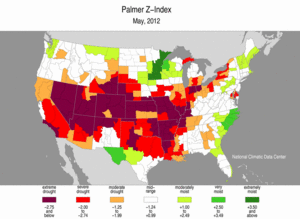
Just right in May - but for how long?

The recent extreme weather conditions beg one to search for more information. Hence, I turned to the U.S. Palmer Drought Indices which consist of three animated charts including short term, long term, and long term cumulative effects of drought and wet conditions. Our area was at a neutral point in May, with not too much or too little rain long term and for our reservoirs and ground water conditions. Is this still the case now in July? Hopefully, in the coming weeks, more rain will head our way.

Explore and see what awaits your area by clicking on this site for the animated charts: http://www.ncdc.noaa.gov/oa/climate/research/prelim/drought/palmer.html

Plants bees love.


I was crusin' the web and came across this image and passing it along for your information and enjoyment.

Sunday, May 27, 2012

New Bees, New Breeds!

On May 12th, we installed 2 additional hives we had purchased from Draper Apiaries. We were surprised to see they were actually from Weaver Apiaries in Texas and not bees raised in the north. We received a very early 6 a.m. call from the post office, urging us to stop by soon to pick them up. We installed the Buckfast bees into Hive C and the Weaver All American in Hive D and they looked vigorous and health. They have been building up very quickly and both queens are laying beautiful sheets of brood. 


There are approximately 6 basic bee stocks in the United States and include: Russian, German, Italian, Buckfast, Caucasian, and Carniolan. These stocks are defined by a loose combination of traits such as temperament, disease resistance and productivity and are divided by species, race, region, population or breeding line. 


The Weaver All American is an Italian bee that they have been improving for over 85 years. According to their website, these bees are gentle and easy to handle, have quick build-up, low swarming tendencies and excellent producers of honey. They are clean, adapt to all climatic conditions, and breed readily with other types. 


The Buckfast bee, largely from the Italian race, was bred by a monk at the Buckfast Abby in Devon, England in the 1920s, to withstand the endoparasitic tracheal mite, Acarapis woodi. These bees are good housekeepers, have excellent grooming behavior which helps reduce disease and produce good honey crops. If not tended regularly though, they can become quite defensive. They are well adaptive to cold winters and breed well with others. According to Weaver Apiaries and a 2 year test of 6 stocks of bees at the University of Minnesota, Buckfast bees ranked as follows:


Brother Adams at his Apiary in Devon


Nosema in Queens - none
Acceptance - BEST (100%)
Spring Buildup - BEST
Gentleness - very gentle (second just behind Midnites)
Swarming Tendency - very low (ranked second)
Propolizing - slight (All Buckfast colonies)
Longevity of Queens - TIED FOR BEST (87% after 16 months)
Wintering - TIED FOR BEST
HONEY PRODUCTION - BEST (during two years)
For more detailed information and excellent charts, summarizing this information,
see the following sites:

http://www.beesource.com/resources/usda/the-different-types-of-honey-bees/
http://www.cals.ncsu.edu/entomology/apiculture/pdfs/1.12%20copy.pdf


Tuesday, May 8, 2012

Bee Happy!


We are still awaiting our northern bred bee packages from Draper.

Our new girls from the south are finally settling in though. We will have 4 hives total - Hive A already lost a queen and we have since re-queened and we found this weekend some laying. Hive B is doing excellent as we have already added the 2nd hive body and she is laying beautiful sheets of brood and they are starting to create lovely honey arcs on each frame. We will have to keep a close eye on this hive to ensure space and discourage any swarming.

This year's spring was so early but now has been just meandering with temperatures in the 50s and 60s, cloudy with intermittent rain allowing for perhaps a a prolonged nectar run?

Those moments, 
when the bees are active, vigorous and there are sheets of brood, 
are something to behold and enjoy!


Thursday, April 26, 2012

Xerces "Bring Back the Pollinators" Campaign


The Xerces Society has created this interesting and thoughtful campaign to bring awareness to pollinators.

Visit their website:
http://www.xerces.org/pollinator-conservation/

Here are some details:

Take the Pledge to Protect Bees

Bring Back the Pollinators is based on four principles: grow pollinator-friendly flowers, provide nest sites, avoid pesticides, and spread the word. With these core values, pollinator conservation can be adapted to any location, whether you tend an urban community garden or a suburban yard, work in a city park or on a farm. Bring Back the Pollinators has already spread from coast to coast thanks to Rapid Refill. Now we are asking you to join in this campaign.

We make the commitment to you that we will work every day to protect pollinators and their habitat. Will you make a similar commitment to the pollinators? Will you sign the pledge?

TO BRING BACK THE POLLINATORS, I WILL:
  • Grow a variety of pollinator-friendly flowers that bloom from spring through fall.
  • Protect and provide bee nests and caterpillar host plants.
  • Avoid using pesticides, especially insecticides.
  • Talk to my neighbors about the importance of pollinators and their habitat.


When you have signed the pledge, you may purchase and install our new pollinator habitat sign in your front yard, community garden, farm, or wherever you are to show your support for pollinators.

Together, we can bring back the pollinators!

Here are just a few things that Xerces is already doing to protect bees:

Wednesday, April 25, 2012

Maple Seed Bounty

The maple trees caught my attention this spring. At first, I thought they were sickly with brown leaves,


but then I realized it wasn't leaves but rather loads and loads of seed pods dangling from the limbs.


Maples seeds are everywhere. As I drive down the driveway, the dried out seeds crackle and pop. Out of the corner of my eye, I catch a glimpse of one whirling and spinning madly down to earth like a miniature helicopter.

There are piles too! 


So, why so many this year?
 Is this some sign of things to come?

We had a dry and warm winter and no damaging frost, which created excellent conditions for the trees to produce a bumper crop of seeds this year. Stress can also cause trees to produce large amounts of seeds. Is this the trees' last hurrah before they die in some impending drought?

According to the NOAA, due to a weak La Nina, our area will experience, through July, normal to cooler temperatures with average precipitation. The trees should be fine!

With all these seeds, you might consider eating them! Squirrels love them. Maple seeds are edible and can be eaten raw and might be tossed into a salad. When cooked, they apparently taste like peas.


Guten Appetit! 


Wednesday, March 28, 2012

Resourceful Queen Carpenter Bee!

While John was cleaning up a honey beehive a couple of weeks ago in preparation of installing our new bees this weekend, he found at the bottom of the hive body, a queen carpenter bee. The hive had died and she had been feasting on the left over honey and had neatly eaten a large section on the bottom. John brought her in to show me:


I gave her some grass and wood to crawl on, some water and some honey to sustain her for another day. 

The following day she was the unexpected guest at a native pollinator presentation I gave. I released her the following morning. 

Carpenter bees are the largest native pollinators in North America and are distinguishable from bumblebees by their shiny black abdomens. 


They are excellent pollinators because of their large size, hairy bodies and early emergence in the spring. They also are early morning risers and work later into the evening and are especially important pollinators for eggplants and tomatoes. 

Using their large powerful mandibles, they dig holes into wood to create their nests, as pictured here: 


They don't eat wood but rather nectar and pollen. If a carpenter bee seems to be flying erratically, flying into windows or your head, don't be alarmed, he probably is just chasing after a female.

Carpenter bees, like all bees, are important for pollination. 
Just think, one of every 3 bites of food come to us from pollinators. 
So, the next time you are biting into an apple, or peach, pear or plum, strawberry or kiwi, 
thank a bee

Without them, these food might not exist and/or would require pollination conducted by hand by humans, which is done now in some places like China, where bees can no longer live due to pollution and over use of pesticides.