Friday, April 29, 2016

Spring Discoveries

It is a blustery, damp, dreary, cold Spring day. It's hard to believe, that it's the end of April. Despite the cold, there are some interesting discoveries, that have been awaiting me in the garden.

First Discovery/Confirmation:
Look what was sparkling amongst the weeds:


Raspberry Dressing Lettuce!!

This is a keeper and something I will be sure to plant yearly!

Second Discovery/Confirmation: 
- The zinnia bed covered in old zinnia stocks did well. Just a few weeds, but overall the soil is in place and in excellent shape. The left over seeds were enjoyed by the over-wintering birds, as well.


- The beds covered in black plastic are in great shape, although the soil was more compacted and reduced. In any case, the soil is like black chocolate cake: moist, crumbly and deliciously perfect for planting new spring plants. 


- The beds covered in weed barrier did not fare well. The barriers were not anchored well enough and simply blew away. Those beds are covered in weeds. Argh!  (See previous post on October 25, 2015)

Spring plantings are well underway. I've planted red, romaine and bibb lettuces and parsley plants and pea seeds and mounded starter potatoes. I threw in a tomato and some eggplant just for fun, but it's been too cool for them to make much progress. 


Sunday, March 20, 2016

Snapper crossing!

Last Thursday afternoon, March 10th, 2 female snapper turtles journeyed from the lower boreal pond and creek, over the road, to the upper pond, where they will reside until the end of summer. It was in the 60's, sunny with a light breeze.

It's a difficult and dangerous trip, as they must cross over a busy road. 

That's where I come in! 

This is the first year in 10 years, that I have witnessed 2 traveling not only on the same day, but at the same time.

The first female followed almost the exact same path as last year, traveling


  up from the creek still covered in thick, wet, black mud. 


and onto my neighbors driveway and then over the road, where 
I stopped traffic, so she could cross safely. 


After crossing the road and safely on the other side, she allowed me to approach her closely without hissing. I could then appreciate her large muscular legs and long claws as she hurried along 
with an ungainly stride.


The second snapper came straight from the pond, through the leaves, vines and branches.


Slowly, she made her way, inching across the driveway and then lumbering up the hill.


As I collected sticks from the winter's winds and keeping my distance, I noticed she continued to choose the most difficult path. 
She walked into some brambles and became tangled in an old wire fence, that took me, 
and some pulling, while wearing thick protective gloves, to get her out.


 Finally, I just carried her the rest of the way, over the road, 
as she wiggled and snapped at me.

I'm so glad to have discovered them, 
to insure their safe travels over the road 
for another season!

For previous snapper turtle encounters, see blog entries: 
May 7, 2010: 

November 20, 2009: 

Thursday, March 17, 2016

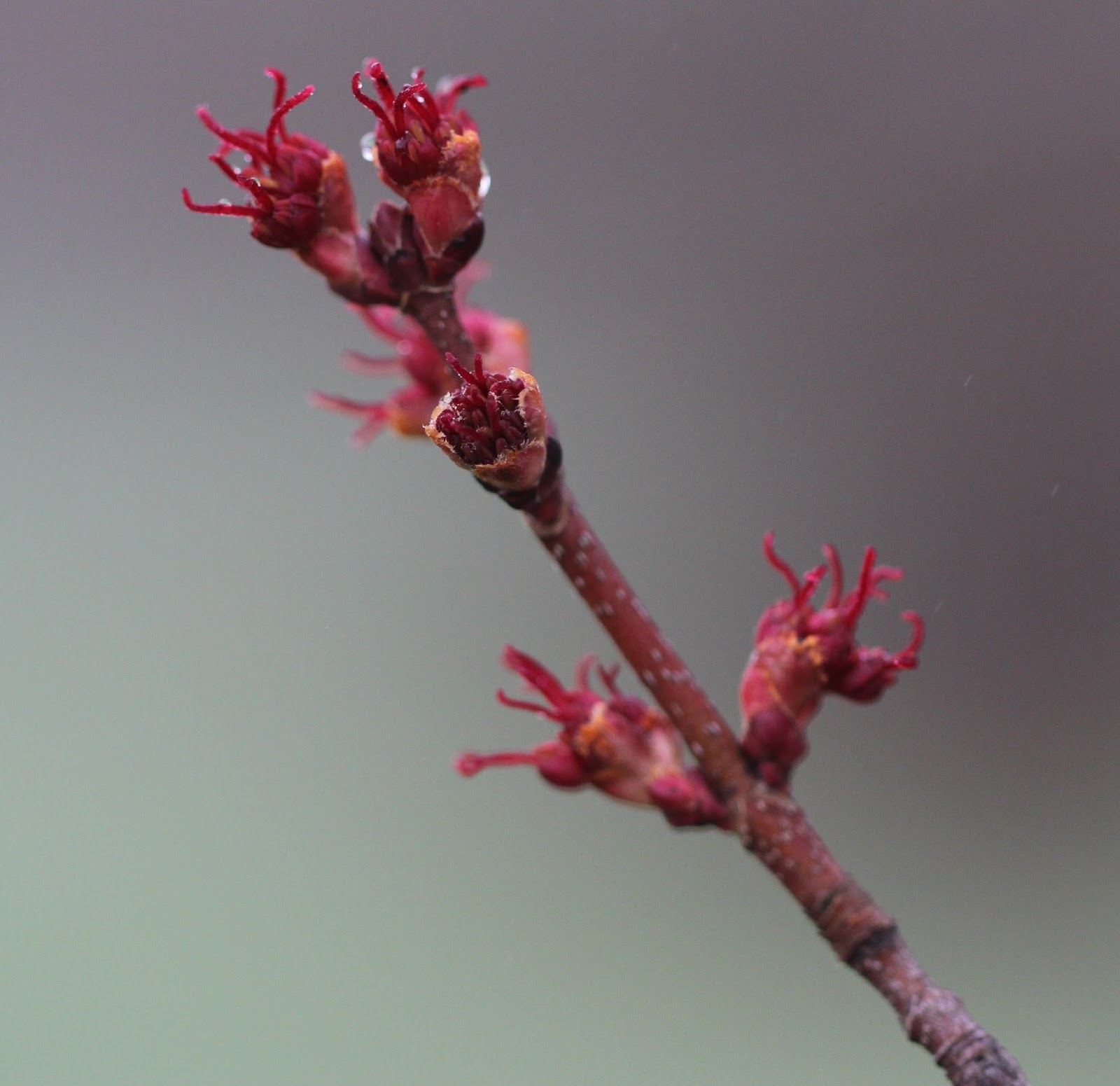
Spring buds

Buds, which are helpful in identifying plants and trees, come in many shapes and types, including: scaly, covered, hairy and naked, as this chart shows beautifully:
(https://en.wikipedia.org/wiki/Bud#/media/File:Plant_Buds_clasification.svg)

Spring is on the way and many buds are popping on this cool, foggy morning.

Magnolia: hairy, covered, terminal


Plum: covered and dew kissed


Red maple: scaly, rounded


Crabapple: scaly


Blueberry: scaly


unidentified: scaly and rounded


Friday, February 12, 2016

Recent Headers


From time to time, 
I post a series of photos I used for the headers of my blog, 
so they are not forgotten. 
The photos are chosen to best reflect the season at hand.


Tuesday, February 9, 2016

Winter Storm Jonas

Starting late January 22 and through the evening of the 23rd, we were hammered with wind and lots and lots of snow - over 30" in just 24 hours. The largest snow fall the area has seen in over 20 years. Surprisingly, there were no power outages in our area.

Here are some photos to mark the event:


Birds took shelter in the nearby trees and grabbed a bite to eat.


It was a quick moving storm and followed
by brilliant sunshine and blue skies for days afterwards. 


Saturday, February 6, 2016

Winter Tree Portraits

A true joy of winter is the observing of trees 
and their beautiful 
varied shapes and structures. 

Their bones.  

Their skeletons.

A foggy evening made for 
a perfect backdrop 
for these tree portraits. 

Maple (Acer)

River Birch (Betula nigra)

Sweet Gum (Liquidambar)

Dawn Redwood (Metasequoia glyptostroboides)

Sunday, January 24, 2016

Winter Buffet

During the winter, birds struggle to find food, shelter and water. You can help by planting a variety of plants, shrubs, vines, grasses and trees that provide berries, seeds and nuts for them throughout the winter. These plants provide not only food rich in calories, nutrients and antioxidants for the birds, but also, beauty, texture and interest for you, as well.

Here are some to consider:

Shrubs:
1. Viburnums such as Cranberry Viburnum (Viburnum trilobum)
2. Staghorn sumac (Rhea typhina)
3. Northern Bayberry (Myrica pensylvanica)
4. Native roses
5. Winterberry (Ilex verticilatta)

Vines:
1. Virginia Creeper (Parthenocissus quinquefolia)

Trees:
1. Oaks (Quercus)
2. Walnut (Juglans)
3. Hickory (Carya)
4. Eastern Red Cedar (Juniperus virginiana)
5. Spruces (Picea)
6. Juniper (Juniperus)
7. Dogwood (Cornus)
8. Holly (Ilex)
9. Hawthorn (Crataegus)

The Green Hawthorn, Winter King,  is a beautiful, pyramid shaped, small tree with small thorns, which has beautiful white flowers in the spring, brilliant red purplish leaves in the autumn and scarlet berries in the winter. 

I have a Green Hawthorn right outside my window, which makes for easy viewing and photographing. In the course of just a couple of hours, I captured 6 different bird species feeding. 

In order for the berries to become soft and edible, they need to go through a few freeze-thaw cycles. 

Here is a robin gobbling down a berry:


A female northern cardinal is finding an abundance of berries on the ground: 


A dark-eyed junco rests and takes shelter after a satisfying meal:


 This cedar waxwing flew in briefly. I hope he tells his friends.


On a neighboring pear tree, a red-bellied woodpecker peeks at all the activity:


The resident blue birds are seen daily on this tree,


including these 2 juvenile blue birds, who stopped by to check out all the commotion:


Another blue bird dives in to partake:


A large flock of robins have lingered for over a week, enjoying the feast daily:


To check which plants are best suited for your area, this website can provide the answers
you need, organized by plant or by state:
http://plants.usda.gov/checklist.html.